
Opinion: Council spending, borrowing and debt is out of control
News Editor
– Whakatāne Action Group chairman John Howard and treasurer Philip Jacobs
At June 30, 2010, Whakatāne District Council borrowings debt amounted to $26.7 million against an annual revenue of $48.9 million – the council’s debt to revenue ratio looked very good at just 55 percent.
Twelve years later, at June 30, 2022, the council’s borrowings debt amounted to $87 million against annual revenue of $90 million – the debt to revenue ratio had risen to 97 percent.
Over the 12 years from 2010 to 2022, the council borrowed on average an extra $5 million a year.
Indeed, in financial years 2013 through 2016, council debt actually reduced year-on-year.
In the 2023 and 2024 financial years, the council’s borrowings debt has risen by $29.8 million and $25 million (estimated) respectively, bringing its borrowings debt at June 30, 2024 up to an estimated $142 million.
The council debt to revenue ratio has now risen to an estimated 127 percent.
We await publication of council’s 2024 Annual Report to confirm final 2024 numbers.
If you think a 14-year increase in council borrowings debt from $26.7 million to $142 million (and an increased debt to revenue ratio from 55 percent to 127 percent) is a cause for concern then hold on to your chair – very firmly.
Not only has council increased its borrowing by five-and-a-half times (vis-à-vis the Tony Bonne and Judy Turner councils) in the past two years, it is proposing to continue this rampant borrowing over the first six years of the just approved Whakatāne District Council Long Term Plan 2024-2034.
Come the end of the 2031 (year seven) council is forecasting borrowings debt of $318.3 million, with the debt to revenue ratio at 209 percent.
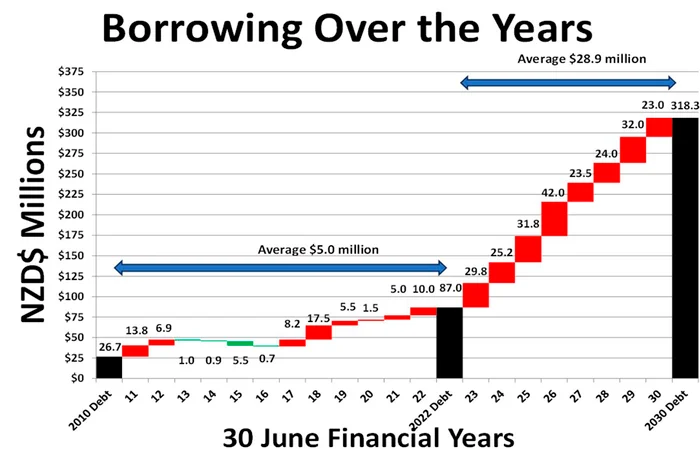
This waterfall graph, pictured above, shows the Whakatāne Action Group’s concerns and the rapid increase in debt that this council has incurred (2023/2024 with 2024 numbers estimated) and is planning (2025 through to 2030).
But all of the forward (infrastructure) spending (and needs?) has not yet been counted.
The government auditor of the LTP pointed out – “the council reduced its planned capital expenditure on Three Waters compliance and resilience-based projects by between 30 percent and 50 percent, due to significant funding constraints.”
The auditor also noted “the council’s plan to defer $260 million of Three Waters capital expenditure for the next 10 years”.
So, there we have it – council borrowings debt at June 30, 2030 (and 2031) is likely to be about $320 million and then there will be $260 million of additional Three Waters unscheduled and unplanned work to do.
Together, $580 million is way too much debt given that it was just $26.7 million in 2010.
The question is, what to do about council’s burgeoning debt?
While it is easy to blame central Government, inflation, Covid, council staff, the council and everything else, the reality is Whakatāne has a problem.
And this is not just a problem in Whakatāne – councils up and down the land are struggling with their finances and echoing claims about a broken funding model causing alarmingly increasing borrowings debt.
But … in the absence of an appreciation of the debt problem and much needed restraint, council carries on like a teenager with access to dad’s credit card and no responsibility for the debt incurred.
As WAG has said elsewhere, council is ploughing ahead regardless.
And while we are talking about credit, let’s review the limits.
Until recently, council had an LGFA debt to revenue ratio borrowing limit of 175 percent. But, now that council has a formal credit rating, the council can borrow up to 280 percent of its revenue.
But on August 9, the Government announced that if council separates its Three Waters functions into a separate entity, council may be able to borrow 500 percent of Three Waters rating income for Three Waters infrastructure.
Enough is enough, who is going to pay back all this debt?
What is the plan? When? Central Government is not going to solve the problem – indeed it is actively contributing to the problem while continuously bleating that local authorities need to control their spending.
Whakatāne Action Group believes that council needs to go back to budgeting and financial basics for the good of the community.
Review FTE, review consultant and contractor costs, review all infrastructure plans, review all spending, etc.
Cancel the nice-to-haves, take out everything we cannot fund from rates, defer every possible project, impose service cuts, impose meaningful staff cuts, cancel staff credit cards, cancel spending delegations, close the cheque book and let the mayor approve all payments.
Council needs to act like it understands the evil of debt and manage it like ordinary families with mortgages, car loans, credit cards and average incomes.
Whakatāne Action Group also believes that community action is needed to fix the problem.
For example, votes put into next year’s council election ballot boxes and submissions made during the public consultation phase of the next long-term plan in 2027 can force cancellation of the Rex Morpeth Hub redevelopment and save $50 million.
Without action, without meaningful change, without dramatic spending reductions, Whakatāne District Council’s burgeoning borrowing debt is rapidly becoming intergenerational theft.
Council is stealing our children’s and grandchildren’s financial well-being.
And beyond the intergenerational issue – if the council does not take drastic action now, it will have no hope of meeting its obligations under the National-led Government’s proposed Local Government (Water Services Preliminary Arrangements) Bill to deliver a Water Services Delivery Plan in 2025 that “is financially sustainable”, meets “drinking water quality standards” and supports “housing growth and urban development”.
Whakatāne Action Group is concerned about these very large borrowings debt numbers.
Yes, we are here for the community and yes, we are here for the long term. But we need the community to help us unwind council’s dysfunctional spending, burgeoning borrowing and debt culture.