
A story of wine, resilience and chasing dreams

Defying the odds: Duncan Smith has written a book about his and his wife, Judy’s, adventures on their small Waimata Valley farm. Photo Kathy Forsyth E5718-00
Kathy Forsyth
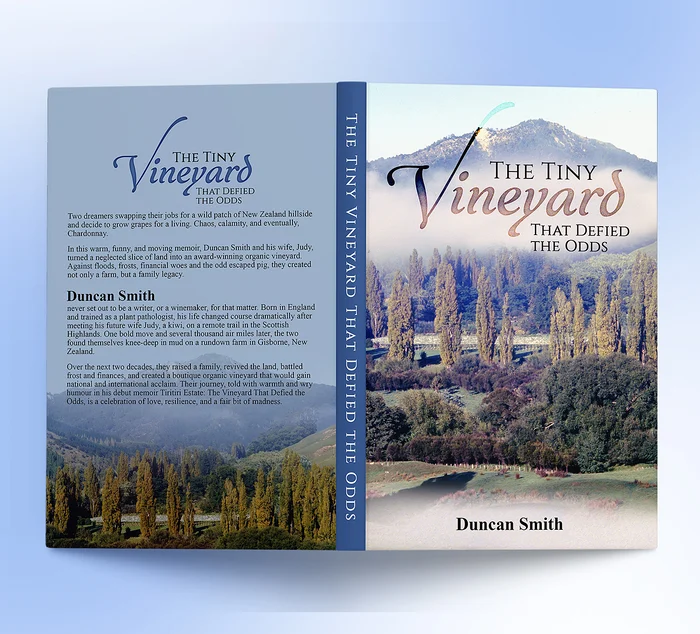
After years of storytelling, EnglishmanDuncan Smith has finally turned his and his wife’s life into words with his new memoir, The Tiny Vineyard That Defied the Odds.
This warm, witty, and heartfelt book captures the extraordinary journey of Smith and his Kiwi wife, Judy – from an unlikely meeting in the Scottish Highlands to their bold decision to build a new life from scratch on a rundown farm in New Zealand’s Waimata Valley, 25 kilometres from Gisborne.
Their story on the farm begins in 1989, when Smith, then a crop research scientist in England, and Judy, a horticulturist and primary school teacher from Whakatāne, traded stability for a dream.
“We bought a little property,” Smith recalls.
“It was 9.2 hectares, and we started from scratch, trying to earn a living from it. We were pretty naïve.
“We thought we could just shut the gate and let the world go by; until the bills started coming in.”
What followed was a story of ingenuity, mistakes, persistence, and a healthy dose of humour.
Determined to make the farm self-sustaining, and live organically, the couple tried growing everything, from a fruit orchard to organic vegetables.
But nothing was easy. A fantastic crop of squash was devastated by rain just before harvest: “We thought, bugger,” Smith said.
“What we need is something we can add value to, and we thought grapes.”
Despite being warned by an expert that grapes would never grow in their valley, a holiday in Crete, where a family friend had a vineyard to give themselves one barrel of wine a year, gave them the courage to try.
“We planted 250 chardonnay plants, thinking we would get one nice barrel of wine for us,” said Smith.
The first year, beetles stripped the vines bare. The second year, the same. On the third, they introduced ducks to eat the pests, a success, but birds devoured the ripening grapes. By the fourth year, they had learned their lessons, covering the vines with nets.
“Harvest came round and we had two barrels of wine.
“We thought we can’t drink all this and so we thought we would try sell some.”
Their first commercial effort earned kudos from a wine critic and a Master of Wine, so the couple planted another 250 vines.
But life in the valley was never easy. Late frosts, wasps, and too much rain repeatedly threatened their crops.
One year, they even lost a promising and valuable vintage to a winemaking error – all 3500 bottles ruined by uncontrolled sulphur levels.
Still, they persevered. Their persistence eventually paid off: a 2014 vintage earned gold and silver medals – locally and internationally.
Their boutique organic chardonnay, once dismissed as impossible, had earned international acclaim, found its way into top restaurants, international buyers, and even praise from royalty.
Their final project was a small batch of sparkling wine made in the traditional méthode champenoise style. After three years of fermentation, it proved “superb”.
Along the way, both Duncan and Judy took on off-farm work to keep their dream alive: Duncan as a research agronomist, and Judy as a qualified horticulturist, teacher, and eventually a master cider-maker.
After 26 years, they sold the farm and retired to Whakatāne, where they now enjoy a slower pace of life, and a well-earned rest.
The Tiny Vineyard that Defied the Odds is more than a memoir about winemaking.
It’s a story about love, risk, resilience, and the pursuit of improbable dreams.
As Smith puts it: “It was a great adventure, for us, and for our boys, growing up in that environment.”
The Tiny Vineyard that Defied the Odds is available at Paper Plus Whakatāne and on Amazon.