Councils unite to explore water future

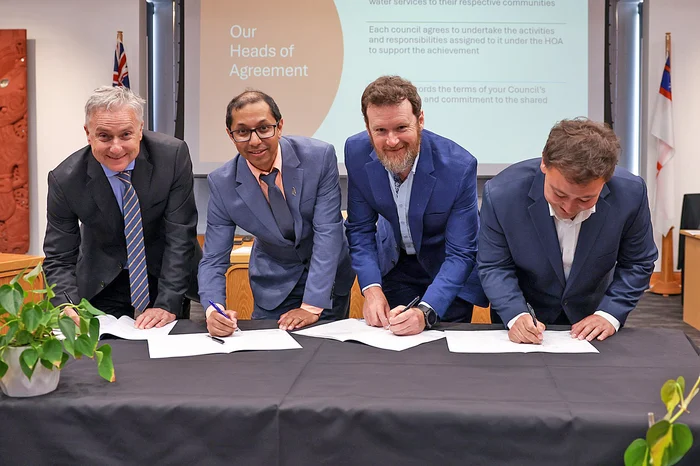
WORKING GROUP: Ōpōtiki Deputy Mayor Maude Maxwell, Whakatāne District Council chief executive Steven Perdia, Whakatāne Mayor Nandor Tanczos, Ōpōtiki District Council chief executive Stace Lewer, Rotorua Mayor Tania Tapsell, Rotorua Lakes Council chief executive Andrew Moraes, Kawerau Mayor Faylene Tunui and Kawerau District Council chief executive Morgan Godfrey. Photos supplied
.
A MILESTONE in future water service delivery was reached this week, with Ōpōtiki District Council Kawerau District Council, Whakatāne District Council and Rotorua Lakes Council, confirming their shared commitment to work together to investigate a joint operating model for delivering water services to their communities.
Mayors and chief executives from the four councils came together at the inaugural meeting of the regional Joint Waters Working Group to sign a Heads of Agreement to investigate the potential development of a combined multi-council Water Service Delivery entity. This follows a Government-approved water services delivery plan and will reflect the needs, culture and values of their communities.
Deputy mayor Maude Maxwell and council chief executive Stace Lewer represented Ōpōtiki District Council at the meeting.
Rotorua Mayor and chair of the Joint Waters Working Group, Tania Tapsell, said councils across New Zealand had been required to determine how they would deliver water services under the Government’s Local Water Done Well legislation.
“It’s been a long journey since Three Waters debates, but the Bay of Plenty Mayoral Forum set the groundwork for the conversations that need to happen.
“In the Bay of Plenty we all want the same outcome – delivering the best future water services for our districts in a way that meets the needs and values of our individual communities and also the Governments requirements.”
All four councils have their own individual Water Services Delivery Plans approved, each outlining a staged approach to future service delivery which will see them providing services in-house and making decisions in 2026/27 for the longer-term delivery of these services. This enables the Regional Joint Waters Working Group to investigate the potential establishment of a multi-council water services council-controlled organisation (WSCCO) for long-term delivery.
“We weren’t prepared to rush our communities through this important decision and remain focused on providing certainty for our individual water services customers in the meantime,” Ms Tapsell said.
Under a potential WSCCO model, councils would retain full ownership through shares with a professional board governing the organisation with elected members providing input through an annual Statement of Expectation.
The WSCCO would adhere to existing relationship commitments to mana whenua, and all formal agreements between councils, iwi and hapū would be honoured.
The WSCCO would set pricing and invoice customers directly, with all pricing subject to regulation by the Commerce Commission.
The collaborative nature of this work means the role of chair and meeting host will rotate among members of the Working Group, with a different council taking the lead for each meeting.