
Letter: Flash $200k loos unnecessary
News Editor
Alexander (Sandy) Milne
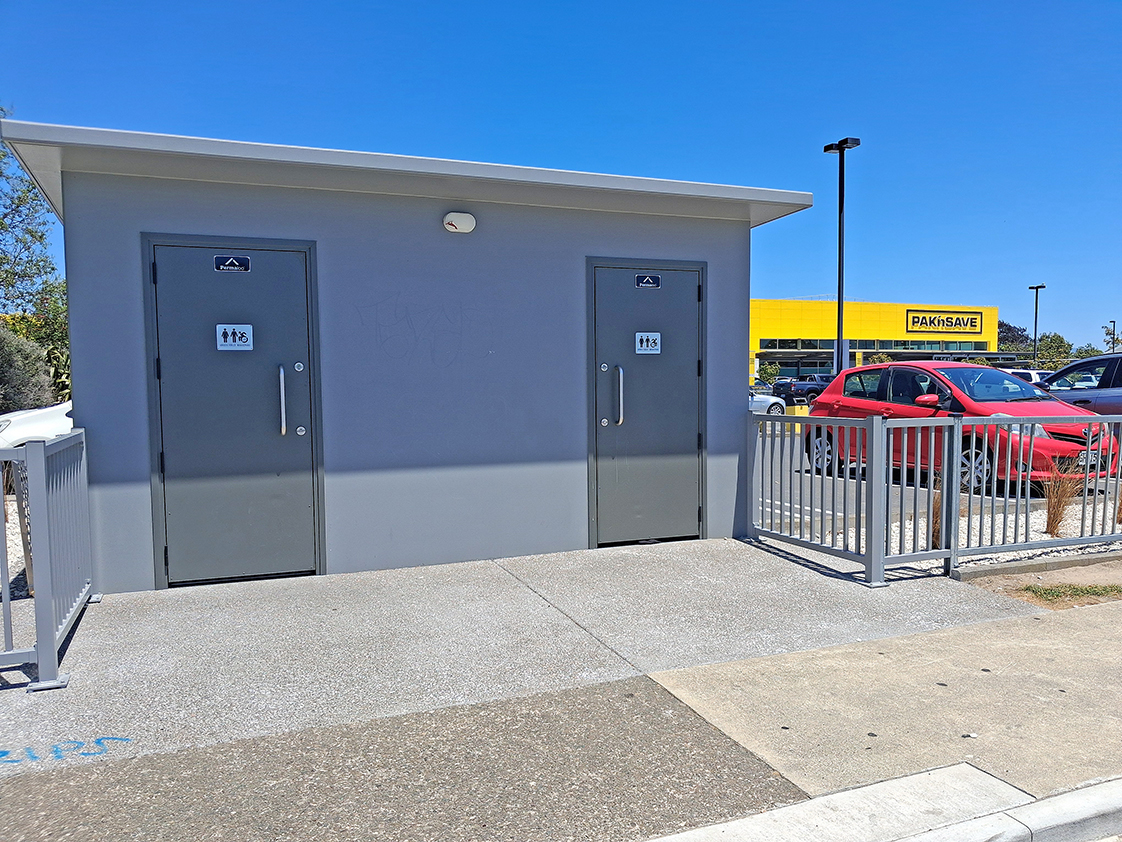
I have seen correspondence between a Whakatāne resident and Mayor Nandor Tanczos regarding the new two-loo public toilet in Lovelock Street, pictured above, which appears to be part of Pak’n Save’s car park.
One cubicle is locked. It seems that they change the operational loo daily.
This flash edifice was built to replace the toilet in James Street, which was the same distance from the supermarket’s entry.
Below is an extract from a recent letter from our mayor to my informant.
“The total cost for the replacement toilet was $200,000, which included toilet supply and install, and associated works including parking provision.
“Annual cleaning and maintenance costs are approximately $9500. Graffiti removal is approximately $300 per minor task.”
Some Beacon readers will be gasping right now, as I did when I heard that news. This $200,000 up front plus $200 every week to provide one unnecessary toilet is yet another example of Whakatāne District Council’s uncontrolled fiscal mayhem.
No wonder our rates are amongst the highest in the land.
And Mr Tanczos has already promised rates rises, which I bet will exceed inflation.
Is there no limit to the folly of our councillors or the council worker who dreamed up that amenity?
There is already a toilet in Pak’N Save, and hundreds of parking places.
I understand that there are many more such instances of ratepayer abuse going on below the radar.
One that comes to mind is the vast amount spent on raised footpaths across roads where, for a fraction of the cost, cheaper ramp-like options would be perfectly safe for mobility scooters and prams.
Can any Beacon reader recall any prior reports of deaths or injuries which could justify such a spend-up?
I’m told that the Goulstone road set-up alone cost us $700,000, and the others cost around $250,000 each.
I invite council staff to provide the costings if my source is mistaken.
The council must sharply reduce the quantum of ratepayers’ money, which their chief executive gets to play with.
■ Whakatāne Mayor Nandor Tánczos responds:
Providing public toilets is an important thing that councils do, but they do get vandalised. A robust design can help.
The decision to close and replace the James Street public toilets was made in 2024 after it became obvious that their condition, design, and repeated vandalism meant that it would cost more to keep refurbishing them.
The council asked the public about this during consultation on the Long-Term Plan.
The $200,000 cost includes the toilet unit, installation, and associated works.
Toilets do need regular cleaning, which costs around $9500 a year and probably isn’t often enough for many people. Toilet cubicles are not generally locked or rotated; any closure is temporary and operational.
On the raised pedestrian crossings, the $700,000 figure quoted is for major drainage and intersection upgrades, not just the crossing.
By comparison, the most recent single raised crossing on Goulstone Road cost $60,000.
It would be great if all we needed to do to make a crossing was to paint stripes on the road but we have to follow national design standards.
These say that pedestrian crossings must be in a 30kmh speed environment, hence the need for the raised platform to slow vehicle speeds.
A zebra crossing on the other hand legally requires pedestrian lighting and other infrastructure, which adds cost and removes parking.
Raised platforms achieve safer speeds without those costs to improve the safety of school children, older residents, disabled users and others who rely on safe walking routes.
If readers have other questions, get in touch.
I’m always happy to clear up any misunderstandings.