
Bomb scare not the intention – defendant
.
The Ōhope man on trial for charges relating to a bomb scare at Whakatāne District Council says he was simply returning “a piece of rubbish” the local body was responsible for picking it up.
Gordon John Dickson, 71, testified that it never entered his mind that leaving an unattended suitcase in a council foyer might trigger a bomb scare.
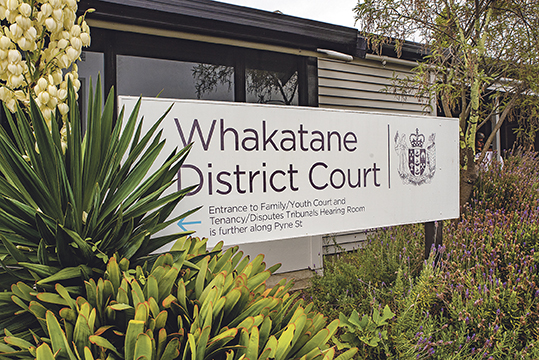
He gave evidence at his own trial at Whakatāne District Court on Friday.
Three police officers and two council employees also took the stand on the second day of the trial.
The first part of Dickson’s trial began in November for charges of trespass and making a false statement that an offence had been committed.
The charges were laid after Dickson dropped a red suitcase in the council chamber’s foyer on May 24, 2024, an area he had recently been trespassed from.
His actions resulted in the building being evacuated, the police being called and the bomb squad being dispatched from Auckland, then stood down.
Dickson accepts he was the one to leave the suitcase in the foyer and told the court he got a passerby to take his photo with it, so he could prove it was him who did so.
When asked why he took the photo, Dickson said he wanted to solidify it was him who did it.
“So no one else could claim it was them. I needed firm evidence to move forward.”
Dickson’s defence is that the council’s reasons for issuing the trespass order were not sufficient or reasonable, and the rules of natural justice required him to have access to a public place.
Dickson was trespassed from the council chambers and surrounding areas due to his alleged behaviour at the council’s Long Term Plan meeting on May 13.
The court heard from two council employees who said Dickson took a photo of them with his phone in “selfie mode” as they sat at the back of the chamber during an afternoon tea break.
Both women were there because the meeting was relevant to their roles, but they were not presenting.
A photo of them was later attached to a request for official information by Dickson. One woman said Dickson requested both their names and job titles, which were disclosed after the council sought legal advice.
Dickson was subsequently trespassed from specific areas of the council building, including the chambers and surrounding hallways. He retained access to the front counter.
The trespass order was to be lifted after three months if Dickson behaved.
He testified that he never took a photo of the two council employees on selfie mode, but that he did take one of them from a distance later with his phone’s back camera, as he did of several other people in the room.
“People take photos all the time. It’s being livestreamed. I reiterate, I never took a photo in selfie mode.”
Dickson said he had no knowledge that he was being trespassed until a council manager showed up at his house.
He said he was keen for him to leave quickly, so he read the paperwork and understood specifics of the order only after he went inside his house.
Police argue that the trespass order was reasonable, that Dickson was still able to participate in public matters virtually, and that he deliberately caused “chaos” at the council with the suitcase because he wanted revenge.
Dickson denied having a sinister motive.
His lawyer, Leonard Hemi, set out to prove that Dickson had a history of collecting items from Maraetotara Reserve and returning them to the council.
Defence exhibits admitted to evidence included photographs Dickson took of other things he considered to be rubbish at the reserve.
They included part of an entrance sign that had rotted and fallen to the ground, a broken stop sign, a wooden pallet with rusty nails, and another broken sign. Some were subsequently returned to the council.
The photographs were to serve as evidence to support an eventual application by Dickson to have the council removed as managers of the reserve.
“As soon as I’ve got some spare money the application can be filed. The Whakatāne District Council is no longer a fit body to look after the reserves,” Dickson said.
In response to Mr Hemi’s question about how he came to have possession of the suitcase, Dickson gave a detailed account of his time in Ōhope since his arrival in 1984.
He said he was known as an environmentalist, had been a conservation board chairman, and had observed a “lack of care” from Whakatāne District Council over the reserves.
Maraetotara Reserve is across the road from Dickson’s house, and he said for about 10 days last May he would clear his letterbox and see the suitcase sitting against the reserve’s upright bins.
He inspected the suitcase and found it to be full of clothes that had been dumped.
Dickson said he took the suitcase home, washed it twice and intended to take it to the council building.
The clothes were to be washed and donated, but Dickson said he retained them after he was charged. He brought them and a similar suitcase to court on Friday.
Mr Hemi asked him why he took the original bag to the council.
“To give it back to the people I consider should have uplifted it, being the Whakatāne District Council.”
Dickson gave a play-by-play of his movements on the day.
It started with an 8.30am doctor’s appointment, then a visit to the bank to pick up money for his rates payment that was due that day. He paid his rates, then went to swim 500 metres as recommended by his doctor.
Dickson said he realised one-and-a-half to two hours later, when he’d left the pool and was driving on Short Street, that he’d forgotten to take the suitcase to the council, so he did so.
The detailed account continued as Dickson described his afternoon, checking the mail, likely opening the garage door, getting out his leftovers and making a coffee.
He said he was halfway through his lunch when he was called by police on a private number – he doesn’t normally answer those, but he did on this occasion – and was asked to return to the council building.
Earlier evidence by police witnesses was that Dickson was identified through CCTV footage, which was then shown in court.
Dickson said he told the police he had a couple of things to do before he could come back but assured the officer that the suitcase was empty and there was no need for anyone to be concerned.
He said he was not expecting a call from the police because he considered it to be a matter between him and the council.
Before returning to town, Dickson sent an email to then-Mayor Victor Luca and another to Eastbay Law.
Dickson said his email to the mayor outlined that he’d dropped the bag off and asked that it be relayed to staff that it was empty, so no possible harm could result. He also used the email to advise he would be contesting the trespass order.
“[The purpose of the email] was to carefully formalise what had happened, to avoid any future doubt.
“It was going to be useful moving forward with the revocation application.”
He explained to the court why he left the suitcase in a foyer he’d been trespassed from and not the front counter, which he could legally access.
“I thought by the time I got home and sent the email, it would be clear to them. I didn’t have the confidence to go to the other reception because I didn’t think council staff would understand the words ‘revocation application’. It’s a good idea to get things in writing with the council.”
Under re-examination, Dickson said parking was easier on Boon Street, but he’d nearly walked into another set of doors at the back entrance two weeks prior because they did not open.
He said he did not want to risk injuring himself, so he entered the part of the building he was trespassed from instead.
Judge Paul Geoghegan queried whether Dickson could have approached the other doors to see if they were working.
“If I placed trust in Whakatāne District Council, then yes. Also, I was in a hurry, Your Honour,” Dickson said.
Upon his return to the council building that afternoon, Dickson saw that Commerce Street had been blocked off. He drove up to the cordon and was told by an officer that he could not park there.
“I nosed my way through one of the plastic cones – no harm, I have a high vehicle.”
He parked, walked around to the back of the building and told a council employee he was there to talk to police.
They had been advised by the bomb squad not to let Dickson near the suitcase with any electronics, according to earlier testimony.
Dickson said he offered to go into the council building and open the suitcase, but he was not allowed in with his briefcase, which contained a laptop.
“I had that because in there, in my laptop, was proof I had notified the council the bag was empty, and they didn’t need to be concerned.”
Dickson was then arrested and led around the building by police to confirm the suitcase on the ground in the council building was the one he’d left there.
Under cross-examination, police prosecutor Jasmyn Pearson said Dickson’s $500 rates payment was made in coins that morning. She put it to him that it was another example of him antagonising the council.
“I view it as an opportunity to get rid of some coins,” Dickson said.
“Council staff have thanked me in the past for giving them coins. It’s legal tender. When the opportunity presents itself, why not use cash?”
The prosecutor put it to Dickson that his actions with the suitcase, following the cash rates payment, was reckless. She said that as someone well versed in the way the council operates, he was bound to know the safety protocols that would come from that behaviour.
“It was not on my mind that anyone would think it was anything other than what it was,” Dickson said.
Evidence concluded at the close of day on Friday, and Judge Geoghegan reserved his decision.
He said while trespass cases were usually quite straightforward, this one was not because it involved a public building.
Dickson was remanded at large until February 12, though the judge may issue his decision prior.