
Exotic flavours freshen forgotten garden
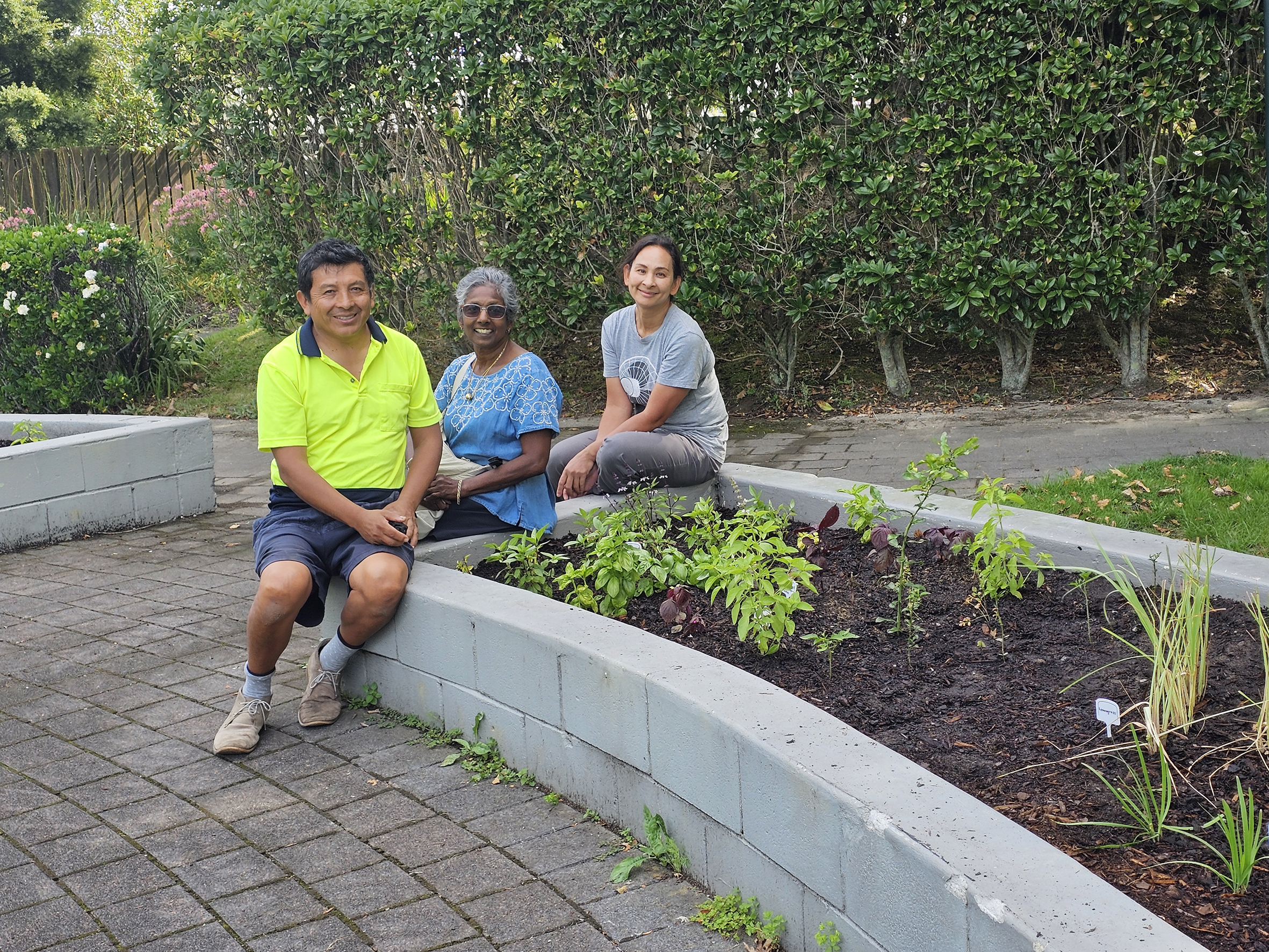
Growing connections: International Community Herb Garden is the work of Abraham Merino, Vasanthi Bradley and Poppy Jansakul. Photo Diane McCarthy E5814-01
Diane McCarthy
Whakatāne Gardens is sporting some new flavours with the help of the district’s international community.
Members of Eastern Bay of Plenty Migrant Advice and Support Trust have gained approval from Whakatāne District Council to create an international culinary herb garden from the unused raised beds next to the Japanese Garden.
Set out in a circular pattern, the four concrete raised beds were formerly established as a scented garden but over recent years had become a neglected mess of weeds.
Poppy Jansakul, originally from Thailand, came up with the idea of planting the garden with a range of international herbs as a way for Whakatāne’s migrant community to share the flavours of their birth countries with locals.
“It is a helpful way for migrants to promote their food culture and make connections with local people,” she said.
The idea sprung from crop sharing activities already happening in the community.
Ms Jansakul was helped to bring the idea to fruition by fellow migrant support trust founder Vasanthi Bradley, and experienced gardener Abraham Merino.
“When I started this project many people advised me to get Abraham involved. I knew him from other community projects and he is quite well known in planting activities such as the Crop Swap organised by Pou Whakaaro.”
Dubbed the lead cultivator and “father of the garden”, Mr Merino had the honour of planting the first seedling.
Ms Jansakul applied for permission to establish the herb garden in the already existing beds, and with the support of Mayor Nandor Tanczos, and councillors Andrew Iles and Carolyn Hamill, permission was granted.
Although the group had not asked for any help from the council, other than the use of the park, the gardens team cleared the weeds and replaced the soil in the beds to facilitate the planting. They have also allowed the group access to the water connection for watering the garden.
The four sections of the garden each have been dedicated to a different continent. The European section is full of herbs that most New Zealanders will easily recognise, including parsley, mint, basil, oregano and rosemary.
Mr Merino has taken the American section of the herb garden under his wing, which includes herbs from his birth country, Bolivia, and other Latin American countries. It includes several varieties of chillies, tomatillio verde and wakataya (black mint) and amaranthus.
Ms Jansakul is in charge of the Asian garden which includes lemongrass, Asian lime, Thai basil, Laos basil and much more.
An African section has also been prepared for planting and is expected to take form in coming weeks.
Ms Jansakul said several local businesses had donated plants for the garden, including the Pana Thai food truck, Viet Eatery, The Wagon restaurant and The Pink Lady gardening service.
The garden has been planted for only a couple of weeks and is still in its infancy, so the gardeners ask that the community allow the plants to become well established before picking anything from them.
However, the intention is for the herbs to be available for everyone as a way of fostering positive intercultural exchanges and promoting sustainable gardening.
Ms Jansakul envisions the garden being the starting point future projects can grow from, such as a culinary herb network, workshops on global gardening traditions and cooking classes where people can learn how to incorporate the herbs into their own dishes.
She would eventually like to work together with other community gardens in the area and businesses to hold cultural events celebrating food from around the world.
If anyone would like to donate a plant to the culinary herb garden the group can be contacted through its Facebook page: “International Community Herb Garden”.