
Ōpōtiki, you have no worries
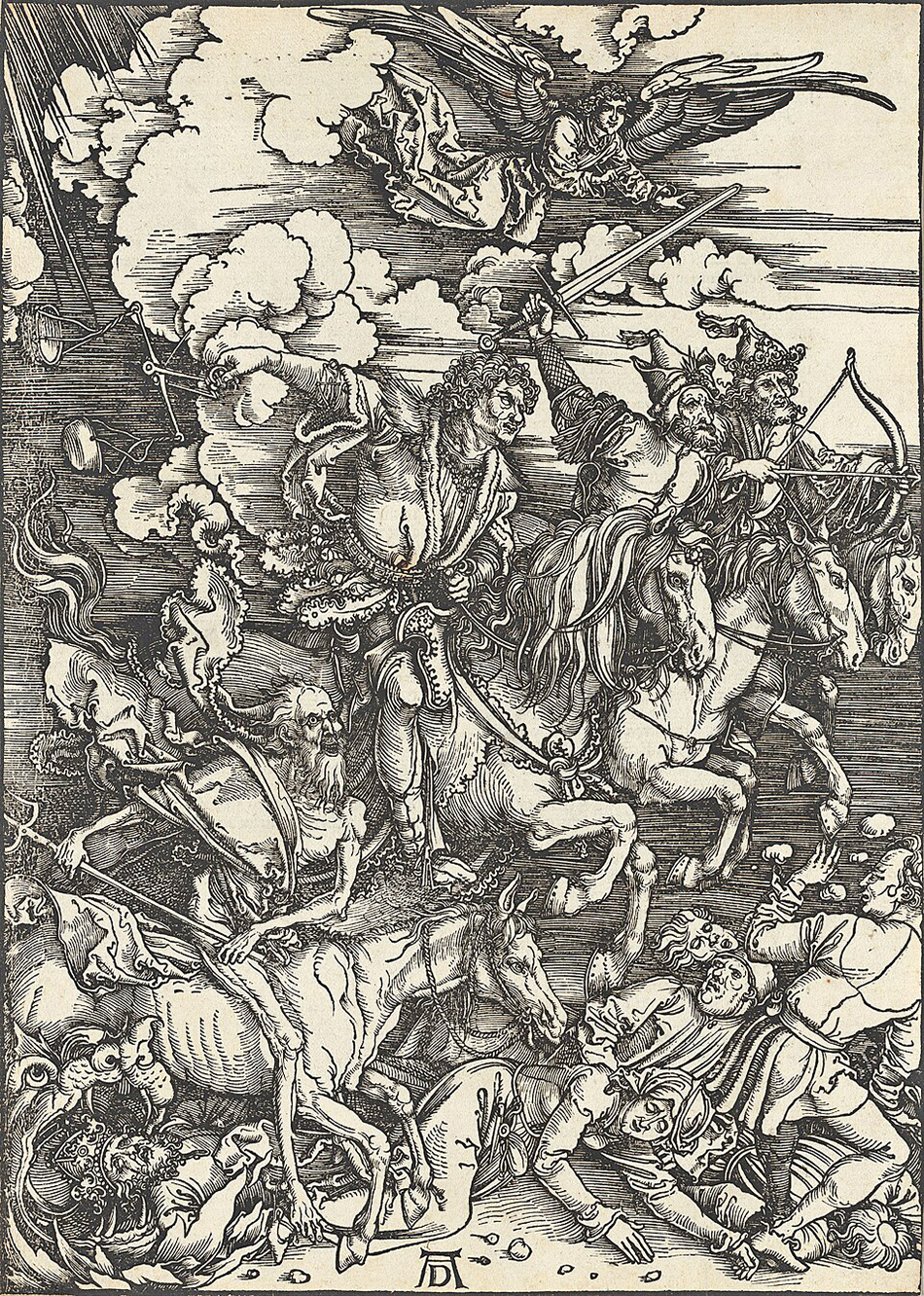
FAMINE: Paul Charman argues Famine, the central figure in the famous etching by Albrecht Dürer, is being welcomed by carbon farming. Photo supplied
.
Paul Charman
When I moved from Taumarunui to Ōpōtiki early last year, it was like arriving in a land flowing with milk and honey.
Cheap houses, thriving orchards and packhouses, walks on the beach, friendly neighbours, and – I’ll take their word for it – great fishing.
There’s a mussel factory that gets propped up by the Central Government, and construction starts soon on a marina and industrial park. Bravo.
Yes, there are social problems, but more where I came from.
Up to 15 police call-outs to family harm incidents a week when I left Taumarunui about a year ago.
I still own a house in the King Country and love its green hills, rivers and mountains – but, compared to Ōpōtiki the writing is on the wall.
The Central North Island town in a valley about 300 kilometres to the southwest now resembles a stage set for the “Scottish Play”.
Remember what the Weird Sisters told Macbeth, he’d be doomed if, “Great Birnam Wood to high Dunsinane Hill/Shall come against you”.
Well, Great Birnam Wood sure has come against Taumarunui – in the shape of rampant conversion of pasture farms into pine.
When sheep and beef properties go on the market there, they’re snapped up by flush investors from out of town.
Some are New Zealand-based companies keen to offset carbon emissions, think Air New Zealand.
Some are big multi-nationals, think IKEA’s parent company, Ingka Investments.
This lot aren’t good neighbours. They don’t maintain fencing or do much pest control.
From time-to-time poorly their sited trees fall onto power and telephone wires, and they plant overly steep hillsides where the trees fall over, accelerating erosion.
There’s minimal effort to thin and prune these carbon forests, but be sure owners have hands extended to collect annual carbon credit payments under the ETS.
All this means Taumarunui has seen its hill country emptied of people.
Schools have closed as the land farewells farming families, farm workers and local contractors.
Shops and businesses have been shrinking and disappearing for years.
The pines themselves generate a fraction of the wealth sheep and beef farms do, and there are dark rumblings from commentators, who see a bigger picture of global food shortages looming as food production is eliminated in an era of climate change.
I expect the arrival of “Famine”, one of Albrecht Dürer’s famous “Four Horsemen of the Apocalypse”, to be hastened by New Zealand’s wrong-headed policy of encouraging carbon forests.
There is no King Country equivalent of the helping hand Ōpōtiki received from Central Government – think $110 million for our new harbour and $52 million to prop up our mussel factory.
Not a bit of it. When two large timber mills near Ohakune closed because of increased electricity prices, in 2024, Shane Jones said, “tut tut”, and kept his wallet closed.
Same when Grand Chateau Tongariro got boarded up due to earthquake strengthening issues in 2023.
Meanwhile, Ruapehu’s two ski fields are on life support due to climate change.
These few lines are not to begrudge government assistance for aquaculture at Ōpōtiki; I just wish the Government gave similar breaks to other towns.
The long-term outlook for Ōpōtiki is bright, like driving into a sunrise.
Horticulture is here to stay, and Brent Chalmers, MBIE’s manager for regional economic development, says Whakatōhea Mussels is still a young, growing operation, which is just facing challenges typical of businesses at this stage of development.
He says the business has started to show positive results from its focus on building operational capability to increase mussel production.
So, the mussel factory, which has lost money every year since it was established in 2014, could be about to turn the corner.
Anyway, as a local historian told me, “When you consider the land Governor Grey confiscated from Whakatōhea in 1866, $52 million seems like a pittance”.
And in the big picture, aquaculture is a positive thing. These guys are on the side of the angels.
As a sustainable food producer in a hungry world, Whakatōhea Mussels will help to delay the arrival of the four horsemen, if anything.
Our sheltered harbour and offshore mussel farm are gifts that will keep on giving for generations, especially when charter boats and other craft begin operating from the marina.
So, it’s all good, as they say. But I wonder whether Ōpōtiki really grasps the special status it enjoys, perhaps best summed up by the brilliant New Zealand-Australian comedian John Clarke, speaking though his alter ego Fred Dagg.
“We don’t know how lucky we are, mate.”