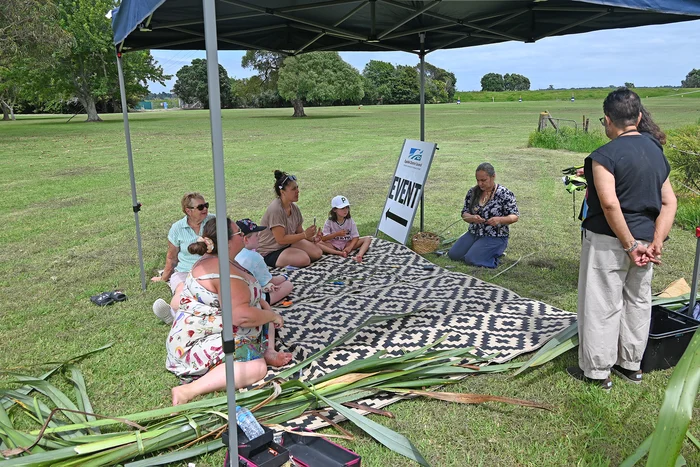
Library holiday activity on harakeke
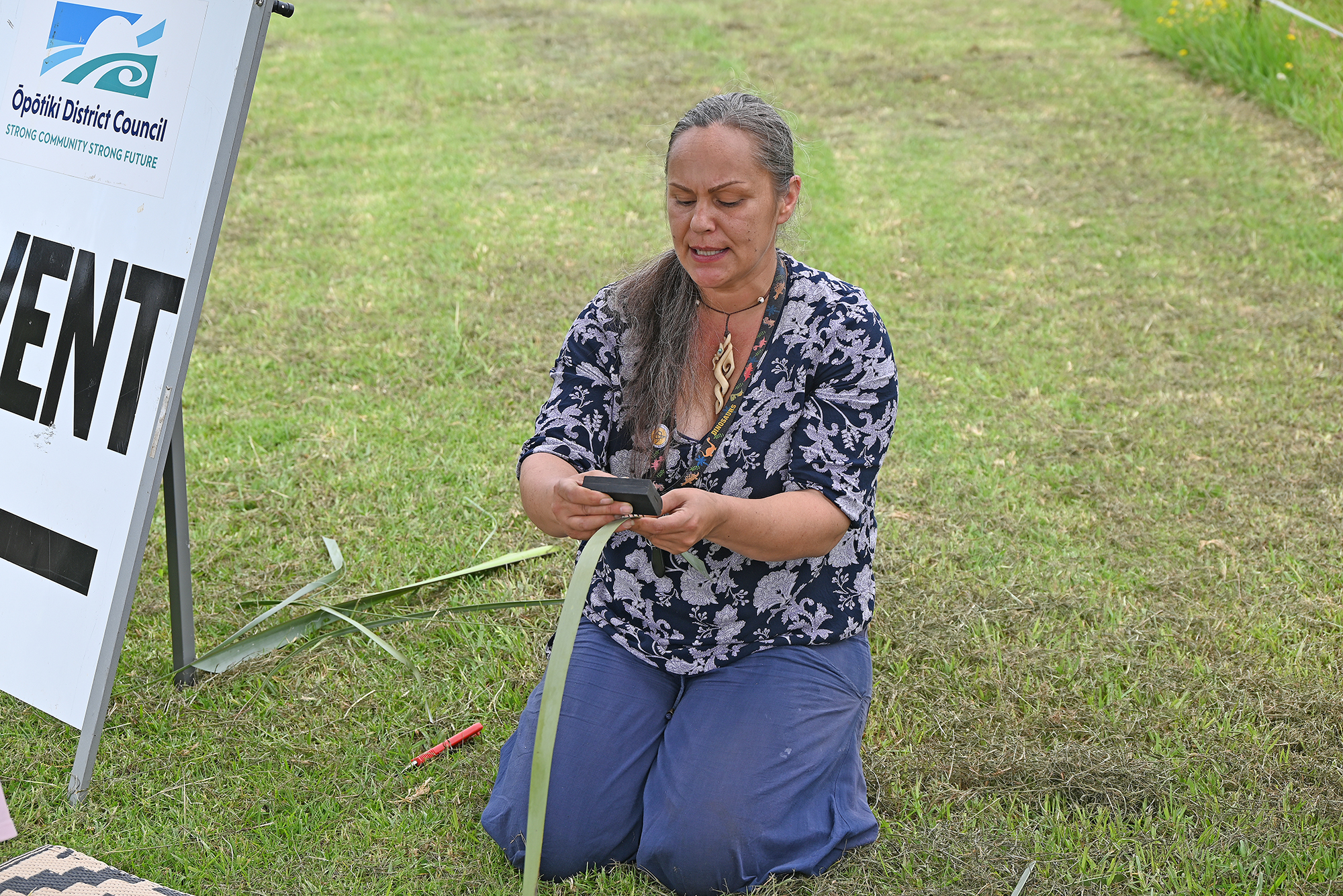
MUCH TO LEARN: Library assistant Hannah Irakau Pehi made things out of harakeke as a child on the marae, then studied the craft in earnest as an adult. Photos Paul Charman E5828-05
Paul Charman
Library assistant Hannah Irakau Pehi led an activity explaining the harvesting and use of harakeke (flax) during the holiday programme at Ōpōtiki’s Te Papa Takaro o Whitikau (skate park) this week.
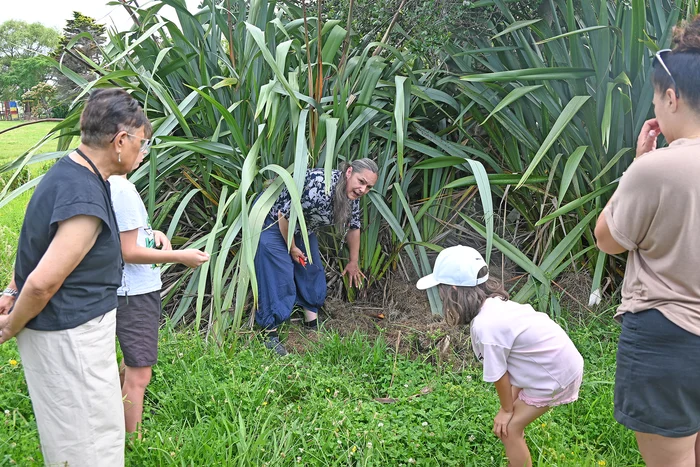
Using plants growing behind the park, a few minutes’ walk from Te Tāhuhu o Te Rangi, Ms Pehi outlined the plant’s many attributes and demonstrated how to harvest and process it.
The activity, called Tikanga Harakeke was the first time in more than three years that the library has run a holiday activity off-site.
It communicated the correct method of harvesting without damaging the plant and gave an introduction to separating the plant’s fibres ahead of use in weaving.
Ms Pehi’s talk also touched on the history of the plant, describing how it was only one of many used in various ways – such as for clothing, rope and binding twine – in traditional times.
She explained how the use of harakeke for the European flax trade encouraged pests and diseases due to monoculture practices, and that traditional practices encouraged diversity in a pā harakeke, thus making them more robust and resistant to disease.
Her talk also touched on the chemistry and physiology of the plant.
Traditions surrounding the correct use of the plant were nearly lost in the push for scaled-up production, only later to be advocated for by many practitioners in later years.
“To them we’re eternally grateful,” she said.
Ms Pehi holds a Bachelors in Weaving and is doing her Masters in Applied Indigenous Knowledge.
Her time working harakeke goes back to childhood, having been taught how to use it on the marae.
“I was always playing with harakeke when I was young but have given the learning of these crafts more priority as an adult, as I have had more time and the agency to do so.
“Now in this holiday activity it’s great to share some of that knowledge.
“Visiting these plants which grow close by helps to create a bridge between the taonga (written knowledge of how to use it), held in the library and the practical application of its use in the field.”
Ms Pehi added that there was a high level of interest in the craft of making manurere (kites) and other items out of harakeke and other natural resources. Traditional material is increasingly seen as having an integrity not present in mass produced synthetics.
“It is relatively easy to source quality harakeke because much had been intentionally grown around Ōpōtiki as this community is rich in the history and expertise of weaving.
“My understanding is that harakeke that stands on public land may be harvested by members of the public, though this should always be done respectfully without harming the plant.
“That is something alluded to in the famous proverb: Hutia te rito o te harakeke, kei whea te kōmako e kō?
“If you pluck out the heart of the flax, where will the bellbird sing?”