
Concepts revealed for $8.6m+ CBD spending
Diane McCarthy
Whakatāne District Council received a quick glimpse of concept designs for integrating the new floodwall with Whakatāne’s central business district at a briefing on Wednesday.
This was ahead of further targeted engagement taking place this week with berth holders, Quay Street residents and other businesses and organisations most directly affected.
Staff had planned a series of public engagement events from March 10, with responses to be brought back to the council in April for decision-making.
However, the council felt it needed further details about the options before putting it out to the public.
Staff were allocated only half an hour to present the concept designs at the briefing and councillors had some unanswered questions about the various options and budget.
Mayor Nandor Tanczos called for a further workshop to familiarise elected members with the plan.
Public engagement would be postponed until after this and at this week’s targeted engagement it was to be made clear that options had not yet been through council.
“To be honest, what I’ve got in front of me is not that clear. I can’t even really see what the design is,” he said.
The district council’s Floodwall Integration Project is to minimise the visual effects of Bay of Plenty Regional Council’s raised floodwall and better integrate it with the township.
The heightened floodwall is part of the regional council’s Project Futureproof to protect the town centre from expected flooding up to 2040.
Council approved a budget of $7.6 million for the project in October last year from funding set aside in the Long-term Plan 2024-2034, and secured central government funding of $4.3 million through the Ministry of Business, Innovation and Employment’s Kānoa funding.
In order to retain the Kānoa funding, the council needs to match it dollar for dollar with its own funds, so councillors had instructed staff to come up with plans with a minimum spend of $8.6 million.
Around $1.3 million of this had already been spent on the Kakahoroa Drive and Quay Street component. This money was paid to the regional council, which largely led the work that included bark, kerbing and stairs.
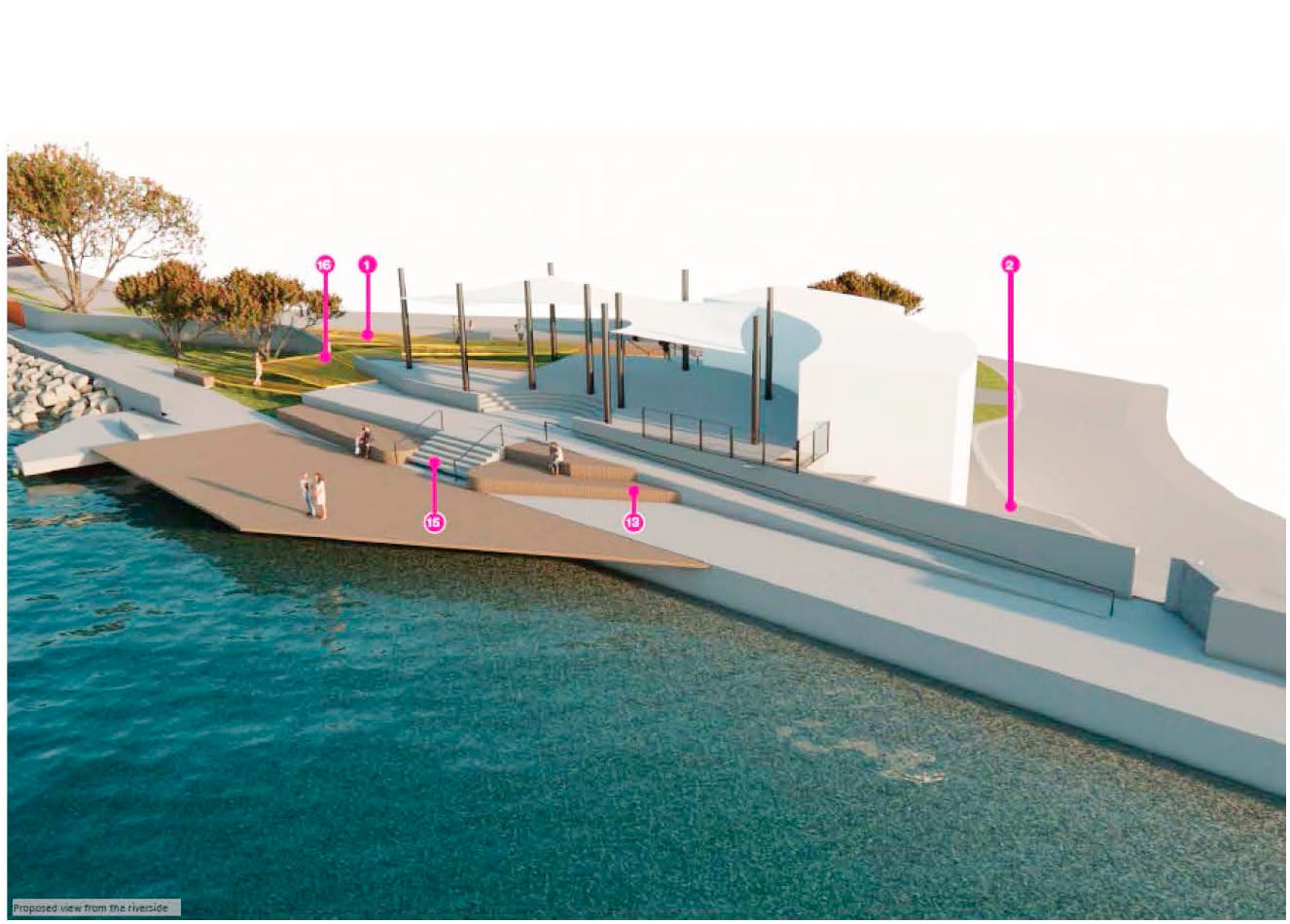
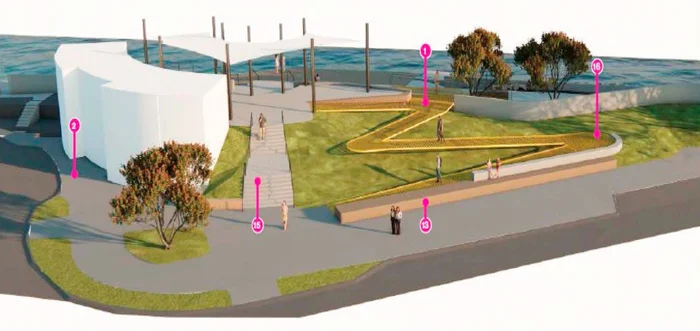
Areas of focus for the next stage of redevelopment are the old isite building, the area across the road from it, on the corner of Quay Street and The Strand, where the council has purchased five buildings for demolition, and the area around Whakatāne Sports Fishing Club and Ngāti Awa Group Holdings land (formerly the Army Hall).
Baseline concepts for a minimum spend include a temporary park on the building demolition site, which would still leave the area open for building development in the future.
Plans for the park are to retain the existing trees and include a half-basketball court and table tennis, and an area for food trucks, picnic tables, planter boxes, raised garden beds and timber benches.
Additional options for further spending of up to $11.9 million, which would use the entire amount approved in the budget, were provided.
These could include stacked timber playspaces, balancing logs, a pump track, a tapu ae court, shade structures and modular seating.
They also include retention of the existing 1930s Art Deco style Plunket Building, which is home to environmental group Halo.
“Some people are certainly interested in the architecture of that building,” said project manager Ian Morton.
“That certainly is an option but there is a cost associated with that.”
The council has still not made a final decision about future use of the former isite building, which is empty. However, concept plans were presented for it to be leased out as a potential food and beverage premises. The design shows the potential for a 160-seat restaurant and bar. Alternative uses include as a venue for films, a pop-up art gallery or installation space.
If the council decided to lease the building, it would be through a public tender process, said strategic property manager Vanessa Fergusson.
“We would be looking for something that attracts people to the area and brings public interaction and life to that space.”
Councillor Lesley Immink pressed staff to provide a “do-nothing” option, save for some planting, which would not use the Kānoa funding.
“Because we wanted to save as much money as possible ... That doesn’t seem to have been presented as an option.”
It was unclear what concepts were planned for around the fishing club or at Otuawhaki, at the water’s edge in front of the isite, as no key was provided for the numbers in the images.