
Judge rules on council bomb scare
.
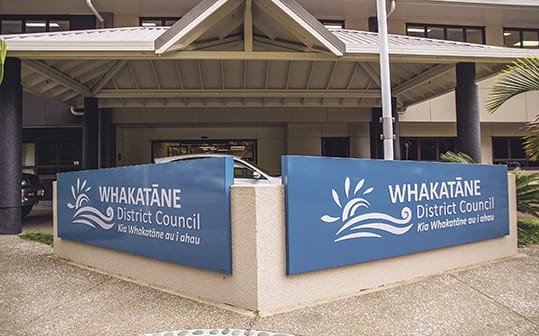
Ōhope man Gordon Dickson knew perfectly well what he was doing when he slipped a red suitcase through the automatic doors of the Whakatāne District Council, sparking a bomb scare.
In a reserved decision reached following a defended hearing conducted over two days in November and December, Judge Paul Geoghegan said he was satisfied that Dickson intended to waste police time and resources and found him guilty.
He will appear for sentence in the Whakatāne District Court on April 15.
On a charge of trespass, Dickson was found not guilty, with the judge finding the trespass notice issued by the council to be “unreasonable, arbitrary and unlawful”.
Police alleged that Dickson, having been served with the trespass notice, breached the notice by placing an empty suitcase in the foyer on May 24.
Police said he should have known such an act would result in the abandoned suitcase being seen as a bomb threat, resulting in the evacuation of the building and the summonsing of the bomb squad.
However, for Dickson it was an act of environmental activism. He said he intended no such outcome and there was an innocent explanation for what happened.
Dickson was served with a trespass notice on May 16, 2024, which prevented him from accessing council chambers where meetings are held, but not the building as a whole.
He was still able to go to the front counter to pay his rates.
The notice came after Dickson allegedly took photos of council staff in a council meeting under the guise of taking selfies, making the staff members feel uncomfortable.
Dickson’s evidence was that he had approached the two young women to ask if they were keen to join the Whakatāne Action Group and had opened his camera to take a photo of the front of the room. It was in “selfie mode” initially so he did not take a photo but switched it into normal mode.
Through his lawyer, Leonard Hemi, Dickson challenged the validity of the trespass notice by the council as a public authority.
Judge Geoghegan noted the order had been made without any consultation with Dickson.
“Although there had been reported distress and concern on the part of employees of the council, that concern did not extend to the need to require Mr Dickson to leave the council chambers at the time of the alleged behaviour.
“A more appropriate course would have been to warn him that any repeat of such behaviour would result in him being required to leave the council chambers and/or be issued with a trespass notice.
“There were no prior reported incidents of concern and given Mr Dickson’s involvement in council issues, preventing him from attending a public meeting was a significant infringement of his rights.”
On May 24, a suitcase was placed slightly inside the council’s automatic doors and abandoned, resulting in a staff decision to call the police and evacuate the building.
Dickson was identified from CCTV footage as the person responsible.
Police were called and before being apprised of who left the suitcase, spoke to a member of the Specialist Search Group, who said they would come from Auckland to assess the suitcase.
On learning it was Dickson who left the suitcase, a police officer telephoned him and was told the bag was for the mayor and there was nothing in it.
Dickson was asked to come to the council, immediately. On arriving sometime later, he attempted to walk past the police cordon and refused to relinquish the bags he was carrying.
He was arrested, placed in handcuffs and taken to the doors of the council building while the constable checked the suitcase.
Between the time he had been asked by police to come to the council, and his arrival, Dickson emailed the then mayor, Victor Luca, saying: “There is a red empty, washed carefully, suitcase that I dropped off at council today to be involved in our existing ongoing legal matter with the Whakatāne District Council over its management of the reserve currently vested in the Whakatāne District Council being the Maraetotara Reserve here in Ōhope Beach.”
He asked that Mr Luca kindly relay this to staff because he had received a call from police saying the building was locked down.
He advised he would be contesting the trespass notice served on him and requested a receipt for his rates’ payment made that day.
Dickson said he’d seen the suitcase for 10 days during his morning walk at Maraetotara Reserve, sitting alongside a green rubbish bin.
Considering it could result in other people adding their rubbish, he took it home, where he found it full of clothing. He washed the clothing and the suitcase, intending to take it to the council because it was the council’s responsibility to pick it up – and it had failed to do so.
He said it was not the first time he had returned an item to the council in similar circumstances.
He had not expected police to get involved and did not think anyone else would see the suitcase as anything other than “an item of rubbish”.
Judge Geoghegan found much of Dickson’s evidence, to be “self-serving and disingenuous” and “lacking in credibility”.
By referring to the suitcase as rubbish, he downplayed it as a perceivable threat or danger. The judge noted that if abandoned at an airport, such a suitcase would have given rise to immediate concern.
Judge Geoghegan said Dickson was an intelligent man who considered the council was failing in its duty towards ratepayers, particularly regarding Maraetotara Reserve.
“I am of the view that Mr Dickson developed a considerable antagonism towards the council, as demonstrated by his actions at the council meeting where he took photographs of council employees.
“It is also demonstrated by his actions in paying $500 of his rates as coins
He said Dickson had been at the council earlier that day paying his rates and could easily have returned the suitcase to the council by entering that part of the council where he was entitled to be.
“Mr Dickson knew perfectly well what he was doing when he slipped that suitcase into the foyer of the council.
“Despite his protestation of innocence, Mr Dickson, in sliding an empty suitcase into a foyer of a public building such as the council, and leaving it there, was behaving in a manner that was likely to give rise to serious apprehension for the safety of those within the building or for the safety of the building itself.
“It is one thing if a person walks into a public building and simply forgets to pick up a briefcase or bag that they had carried into the building. These circumstances are quite another.”