
Opinion: Housing an important issue for EBOP - and is being addressed
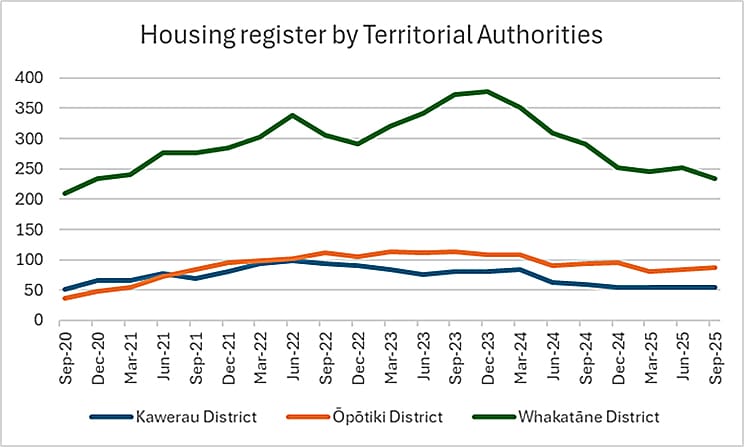
■ Source: housing-register-september-2025.
.
■ There has been a lot of talk about housing in the Eastern Bay and I wanted to set out what the Government has achieved in recognition of the significant deficit of good quality housing in the regions, writes East Coast MP Dana Kirkpatrick.
Much of the recent debate arose from the proposed “move on orders”, which would allow police to respond to disruptive or intimidating behaviour, particularly when it relates to these powers intended to address “disruption and disturbance” in busy areas, not to penalise people experiencing hardship.
Just as the gang patch ban has delivered new mechanisms for dealing with crime, these “move on” orders will help engagement and give the police tools when they need them.
On the housing front, there’s encouraging news for the Eastern Bay, with the number of households waiting for public housing trending downward as new homes come online and more whānau are placed into stable housing.
The latest figures show 375 households remain on the Housing Register across Whakatāne, Ōpōtiki and Kawerau.
A significant drop from the peak of 573 in December 2023, and a return to around 2020 levels.
Although demand is still present, the shift signals real progress in getting people into homes.
For those interested, the number of people on the Housing Register on the Gisborne side has reduced from 624 in December 2023 to 387 in September 2025. Whakatāne continues to see the highest need, with 234 households waiting, followed by Ōpōtiki (87) and Kawerau (54). But alongside this demand, there’s strong movement on the supply side.
Kāinga Ora now manages 688 public homes across the Eastern Bay, with the bulk in Whakatāne (470), as well as 101 in Ōpōtiki and 45 in Kawerau. Importantly, the pipeline is far from slowing down.
A further 54 homes are under construction and set to be delivered this year; 25 in Whakatāne and 29 in Ōpōtiki, adding to the 90 homes already built or purchased across the region over the past five years.
That momentum is translating into real outcomes. Over the past 18 months alone, 107 new tenancies have started locally, including 87 households who were previously on the Housing Register; a clear sign that more families are finding a place to call home.
Across the wider Bay of Plenty, housing delivery has ramped up at pace, with tenancy placements jumping from 81 in 2021 to 556 in 2025. This reflects a region-wide push to tackle housing need head-on.
And there’s more to come. Government-backed investment is set to deliver 537 new social and Māori homes across the wider Bay of Plenty, with 113 already completed and hundreds more in the pipeline.
This is being done through a combined Community Housing Provider (referred to as a CHiP) of local iwi Ngāti Awa, Tuwharetoa and Whakatōhea.
The growth isn’t limited to public housing either.
Census data shows a steady rise in private dwellings across all three districts since 2018, adding further capacity to the region’s housing stock.
Though challenges remain, this is a huge step forward.
The direction is clear: more homes, more healthy safe families, a better Eastern Bay.