‘Greenest town in Southern Hemisphere’
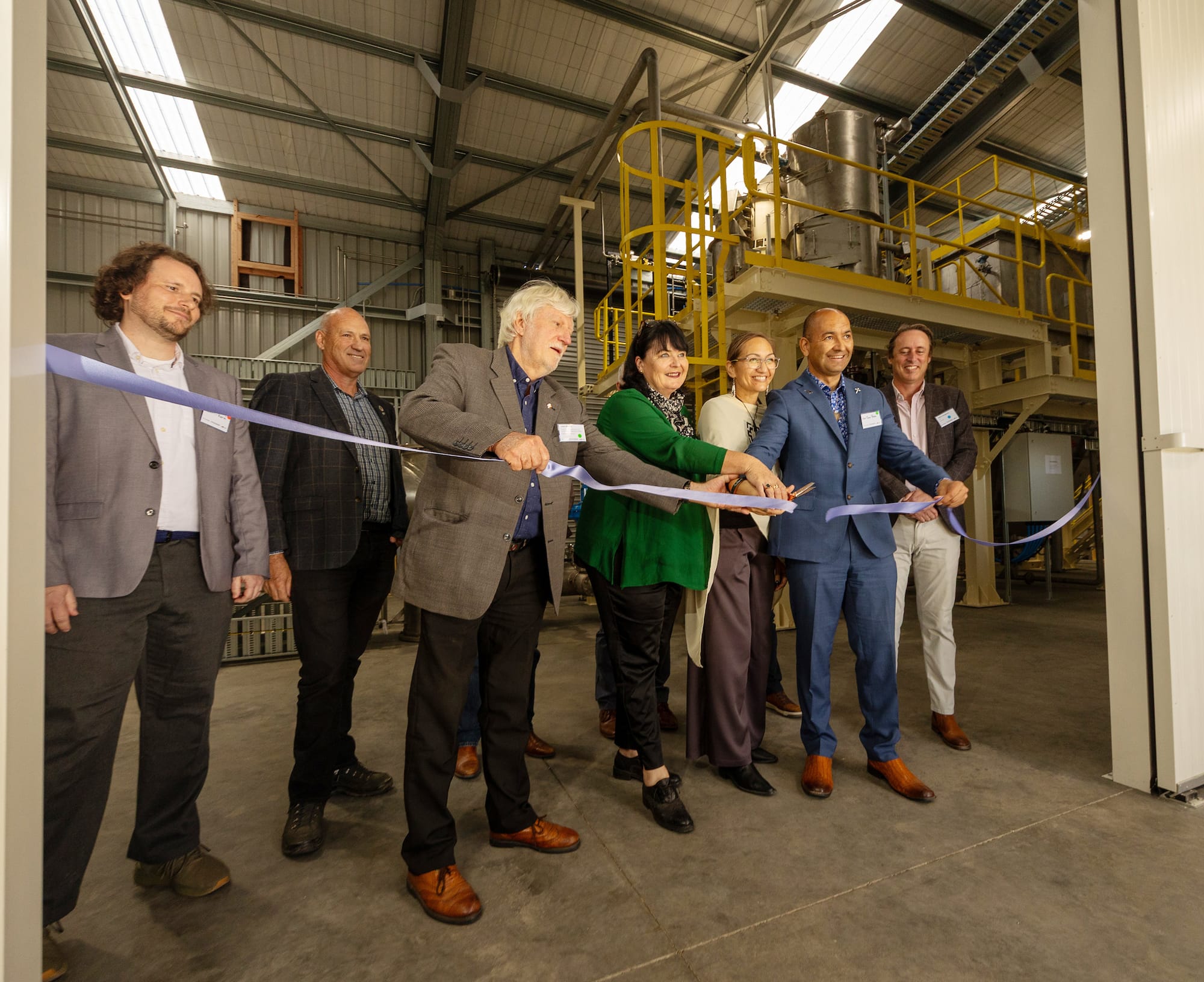
Ribbon cutting: PyroGenesis Canada lead process engineer Jean-Rene Gagnon, Trust for the Destruction of Synthetic Refrigerants chairman Richard Lauder and founding director John Bowen, East Coast MP Dana Kirkpatrick, Kawerau Mayor Faylene Tunui, Minister for Conservation Tama Potaka and Chemical Destruction Services director Clifton Madgwick. Photo Jamie Troughton/Dscribe Media
Diane McCarthy
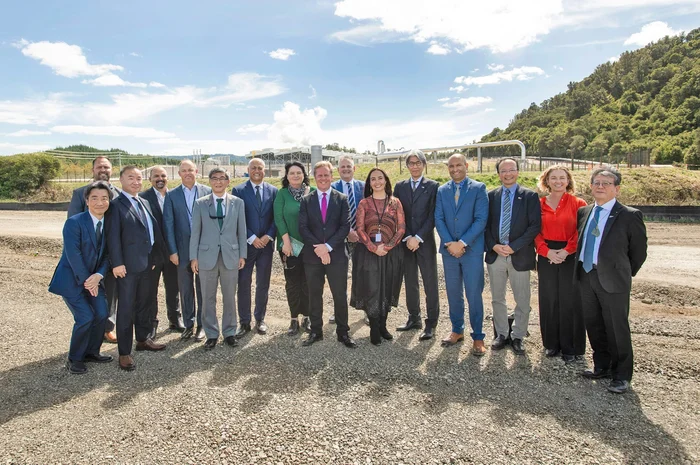
For Kawerau, Friday was a celebration of innovation, collaboration and environmental stewardship as two new “green” facilities were officially opened.
Government ministers were out in force, with Conservation Minister Tama Potaka cutting the ribbon on the new John Bowen National Refrigerant Destruction Facility while Minister of Trade and Investment Todd McClay inaugurated Eastland Generation’s TOPP2 geothermal power plant. East Coast MP Dana Kirkpatrick and Labour list MP Jo Luxton also attended the events.
The $10 million world-leading refrigerant destruction facility is the first of its kind in New Zealand.
Using a plasma steam torch reaching 5000 degrees – about the same temperature as the surface of the sun – the world-class facility will blow apart synthetic refrigerant gases into individual atoms.
Recombined into safe, stable compounds such as water vapour and salt, the plant will produce no waste streams or wastewater.
Chemical Destruction Services (CDS) managing director Clifton Madgwick said the plant had the capacity to sustainably destroy up to about 100 tonnes of refrigerant gases a year, including CFCs, HCFCs and HFCs. This was equivalent to 220,000 tonnes of carbon dioxide.
Refrigerants are removed from old fridges and air conditioning units at stations around the country and stored in gas tanks, which have previously had to be shipped to Australia for destruction.
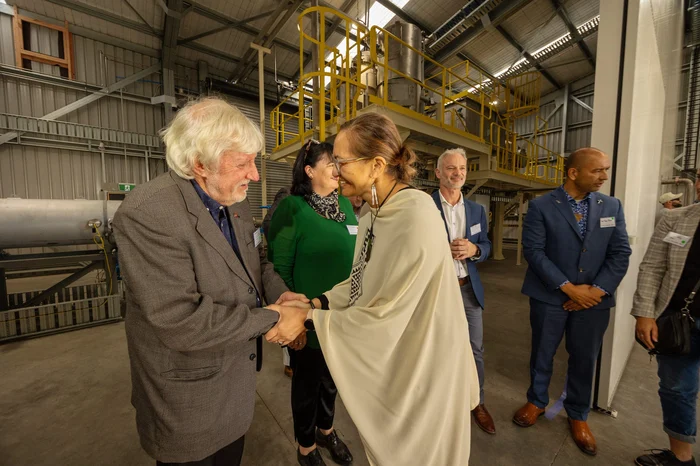
Industry stewardship organisation the Trust for the Destruction of Synthetic Refrigerants, or Cool-Safe, which pays a bounty for the refrigerant gases, has funded the facility through international emissions trading.
Trust chair Richard Lauder said the plant represented the beginning of a new chapter in advanced environmental stewardship and action on dealing with end-of-life refrigerants in New Zealand.
He said synthetic refrigerants were the “invisible backbone” of modern New Zealand and its export success around the world.
“They touch every corner of New Zealand, and reliance on them is growing exponentially – from home and commercial air-conditioning, healthcare, supermarkets and foodservice to logistics and cold chains.”
Harmful refrigerants no longer needed to be stockpiled, reused indefinitely, or shipped offshore.
“They can be permanently destroyed onshore using world-leading technology, powered by home-grown renewable energy.”
While recycling and reclaiming gases had a place, he said this extended the life of these gases – extending the legacy of older refrigerants.
“Ultimately, to fully address the climate impact, these gases must be safely and permanently destroyed when they reach end-of-life. And now, that solution exists here in New Zealand.”
He said the world-class facility was a demonstration of what was possible when industry, Government, and community worked together with shared purpose.
He acknowledged John Bowen, who attended the opening, as the founding director of the trust, and who had served for three decades for the cause.
The plant is in a purpose-built facility leased to CDS by Kawerau Enterprise Agency (KEA) at its industrial park.
KEA general manager Kevin Power said he had been working with CDS for more than five years to get the plant operational.
“This makes Kawerau the greenest town in the Southern Hemisphere. Kawerau is now actually climate positive,” Mr Power said.
Creating the custom-designed building from bare land was no easy task for the not-for-profit organisation, which is self-funded through its real estate assets to encourage industry in the town.
“It was a mission,” Mr Power said.
“The loan rates at the time didn’t make it economic, so I had to get very creative. I got Trust Horizon involved, but they don’t loan on buildings. So, we created some green bonds, through community finance, which they could invest in.”
Mr Power said despite some initial fears from the community that required some lobbying, resource consent was not difficult to obtain as the plant did not emit anything harmful into the environment.
“Everything that comes out of here is benign. It’s a completely climate positive process.
“I’ve kind of pinched myself that it’s actually happened.”
Next on the agenda on Friday was the official opening of the 49 megawatt TOPP2 geothermal power plant, which has been operating since December.
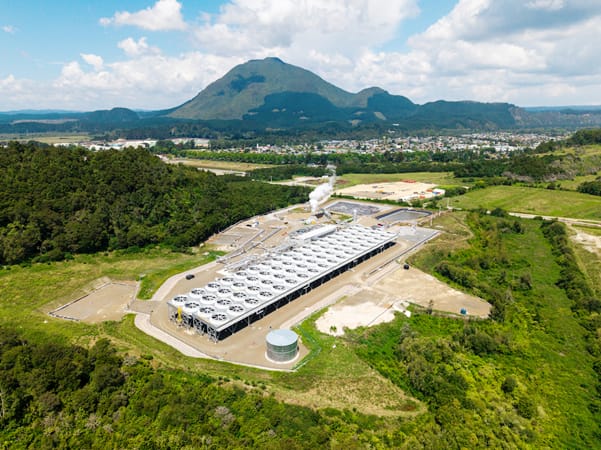
The power plant is a partnership between Eastland Generation and tangata whenua-owned Ngāti Tūwharetoa Geothermal Assets.
Eastland Generation is co-owned by Tairāwhiti Investments and Obayashi Corporation and TOPP2 is the largest of its four geothermal power plants in the Bay of Plenty, including TOPP1, which is also a partnership with Ngāti Tūwharetoa.
“Since 2005, Tūwharetoa mai Kawerau ki te Tai has exercised kaitiakitanga over the geothermal reservoir in Kawerau, alongside our commercial developments, to deliver long-term value for our people,” said Tūwharetoa Group chief executive Robbie Watt.
“The TOPP2 power plant, built here on our whenua and powered by our geothermal energy, reflects the strong partnership with Eastland Generation in delivering renewable energy. It demonstrates iwi leadership, innovation, and strong commercial partnerships in action.
“This project is about more than energy – it is about inter-generational opportunity and a sustainable future.”
Kawerau Mayor Faylene Tunui said Eastland Generation and Cool-Safe were both helping cement Kawerau’s position as a centre for sustainable energy and “kaitiaki taiao” (environmental stewardship).
“Eastland Generation’s partnership with Ngāti Tūwharetoa Geothermal Assets demonstrates the promise and potential of commercial developments where iwi are side-by-side.
“Our iwi-owned company provides the steam, and Eastland Generation converts it to electricity for New Zealand.
“Access to reliable and affordable electricity helps power and protect Kawerau’s role as a leading environmentally conscious industrial hub,” said Mrs Tunui.
Last year, Kawerau District Council adopted a regional economic development plan alongside Whakatāne and Ōpōtiki district councils.
The plan’s ambition is to position Kawerau as a leading centre for clean energy generation, emissions reduction, and value-add manufacturing.
To unlock this potential, the council secured an exemption to the government’s “district plan stop” as part of the Resource Management Act reforms. With this exemption council is pursuing a District Plan change to rezone rural land into industrial land.
“Cool-Safe’s refrigerant destruction facility brings world-leading technology to Kawerau. This contribution, made in Kawerau, helps New Zealand meet its international obligations to reduce emissions,” Mrs Tunui said.
“Our dream in Kawerau is to prepare the next generation of world-leading specialist engineers, IT experts, and taiao/environmental protectors who’ll keep generating new “firsts”’ right here at home”.