
Making scootering safe and simple for all
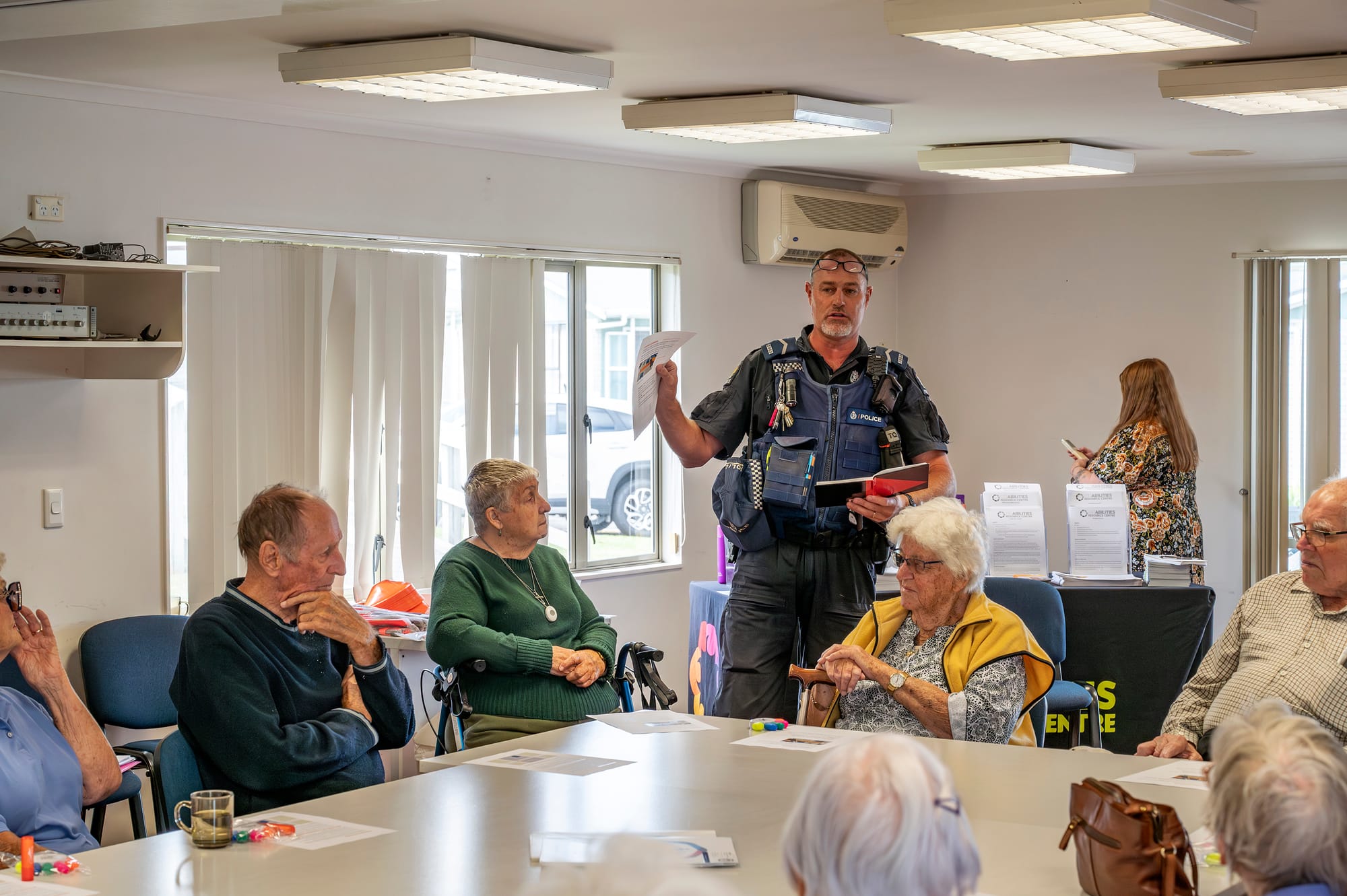
Safety First: Mike Chelley explains the legal aspects of mobility use. Photo Troy Baker E5933-10
Troy Baker
Mobility scooter users have received a helping hand in how best to navigate the footpaths and streets of Whakatāne safely.
About 20 mobility scooter users took advantage of a safety course run last week by the Disability Resource Centre in conjunction with Whakatāne District Council road safety and New Zealand Police.
Rob Jones, Whakatāne’s community police officer, and Mike Chelley, a road accident analyst, were on hand to explain and answer legal questions relating to footpath and road use.
One point of confusion raised was the difference between courtesy crossings and pedestrian crossings, as they are not the same. Mr Chelley explained the legal distinctions.
“Most people mix up courtesy crossings with pedestrian crossings. At courtesy crossings, cars have the right of way. We’ve had a few accidents where people just zoom out without checking for vehicles. At pedestrian crossings, vehicles must give way to pedestrians and mobility scooters,” he said.
He recalled an incident involving a scooter and a vehicle at a courtesy crossing. Fortunately, no one was injured, but similar incidents elsewhere in the country have resulted in harm.
Richard Hamer from Whakatāne District Council’s road safety team said most crossing points in Kope were courtesy crossings, which were typically installed in low-traffic areas.
“However, you should never just charge across without checking for cars,” he said. “Originally, councils were told to paint courtesy crossings red, but research found that users assumed this meant they could walk straight out, so they are no longer painted,” Mr Hamer said.
Mobility scooter users also raised concerns about crossing points that were not raised, creating unstable surfaces. Mr Chelley discouraged users from taking to the road to avoid these areas because mobility scooter users were not legally permitted to use the road unless no footpath was available.
Course leaders emphasised the need to be cautious, be safe and be seen.
They said flags and even bells were useful scooter additions, but they were no substitute for awareness and common sense.
Key safety considerations include keeping left, staying aware of your surroundings, reducing speed in crowded areas, and watching for vehicles exiting driveways. Legally, vehicles crossing footpaths must give way to footpath users. Users should also be mindful of shared pathways, such as Warren Cole Walkway. With mobility scooters, cyclists, and pedestrians all using the same space, it’s important to keep left, alert others to your presence where possible, and be respectful.
Mr Hamer said if mobility scooter users encountered vehicles blocking footpaths, they should contact the council. It was also helpful to take a photo showing the vehicle, licence plate, location, and time.
He acknowledged that enforcement could be difficult with the council having only two parking wardens.
Mr Chelley also outlined what mobility scooter users should do if they were involved in an accident.
“Call 105 if the accident is non-emergency. This is important as it helps police identify potential problem areas. If you don’t report it, nothing can be done. These incidents must be reported within 48 hours. If it’s an emergency, call 111; you are required to report those incidents within 24 hours,” he said.
It is important to do your research when choosing a mobility scooter, ensuring the model is an approved device.
The Disability Resource Centre provides a list of recommended options for those unsure. Approval is often determined by wheel size, with larger scooters potentially requiring road registration.