
Opinion: Where is Whakatāne Hospital’s MRI Scanner?
.
Victor Luca
An update on the MRI scanner that was supposed to have come to Whakatāne Hospital is on the agenda at the next Grey Power meeting – to be held at the Knox Presbyterian Church Hall at 10am on Wednesday, April 15.
At the meeting I will provide some background on the direction of health privatisation in New Zealand and an update of the diagnostic imaging situation at Whakatāne Hospital, with specific reference to the MRI scanner that was supposed to have been installed two years ago.
That will be followed by an open floor and then a cuppa. All welcome as usual.
Until the discovery of X-rays by Wilhelm Röntgen in 1893, the only way to see inside the human body was by vivisection. That is, by cutting into the body while the subject was alive. I’m glad to have been born in the 20th century.
Planar X-ray imaging was the only way of seeing inside the body until about 1972.
In this technique, X-ray light passes through the body and an image registered on a flat photographic plate located behind the patient.
Today, we use electronic detectors. X-rays are ionizing radiation and the X-rays passing through the body are attenuated by different degrees by different parts of the body.
The result is a one-dimensional image. Because X-rays are ionizing radiation, over time exposure can cause damage to human tissue.
Today, it is possible to record three-dimensional images by collecting X-rays in multiple planes using a circular arrangement of electronic detectors.
Highly sensitive detectors mean you can get high-resolution images with only low X-ray doses.
A computer is then used to reconstruct the images recorded on the detectors into a three-dimensional image of anatomical structures.
This is X-ray Computed Tomography or X-ray CT, sometimes also referred to as a CAT scan.
Today, developments in medical physics have given us an array of sophisticated techniques for getting highly detailed images inside the human body that are invaluable for diagnosing disease.
Other techniques use radioactive isotopes that are injected into the body.
The radiation emitted by the isotopes passes through the body and is imaged again using a circular arrangement of detectors.
Techniques that use isotopes include Single Photon Emission Computed Tomography (SPECT) and Positron Emission Tomography-Computed Tomography (PET-CT). Another imaging modality is ultrasound scanning which uses non-ionizing radiation.
The Magnetic Resonance Imaging (MRI) technique does not use ionizing radiation but rather radiofrequency excitation of protons present in the molecules of the body combined with powerful magnetic fields provided by helium cooled super-conducting magnets.
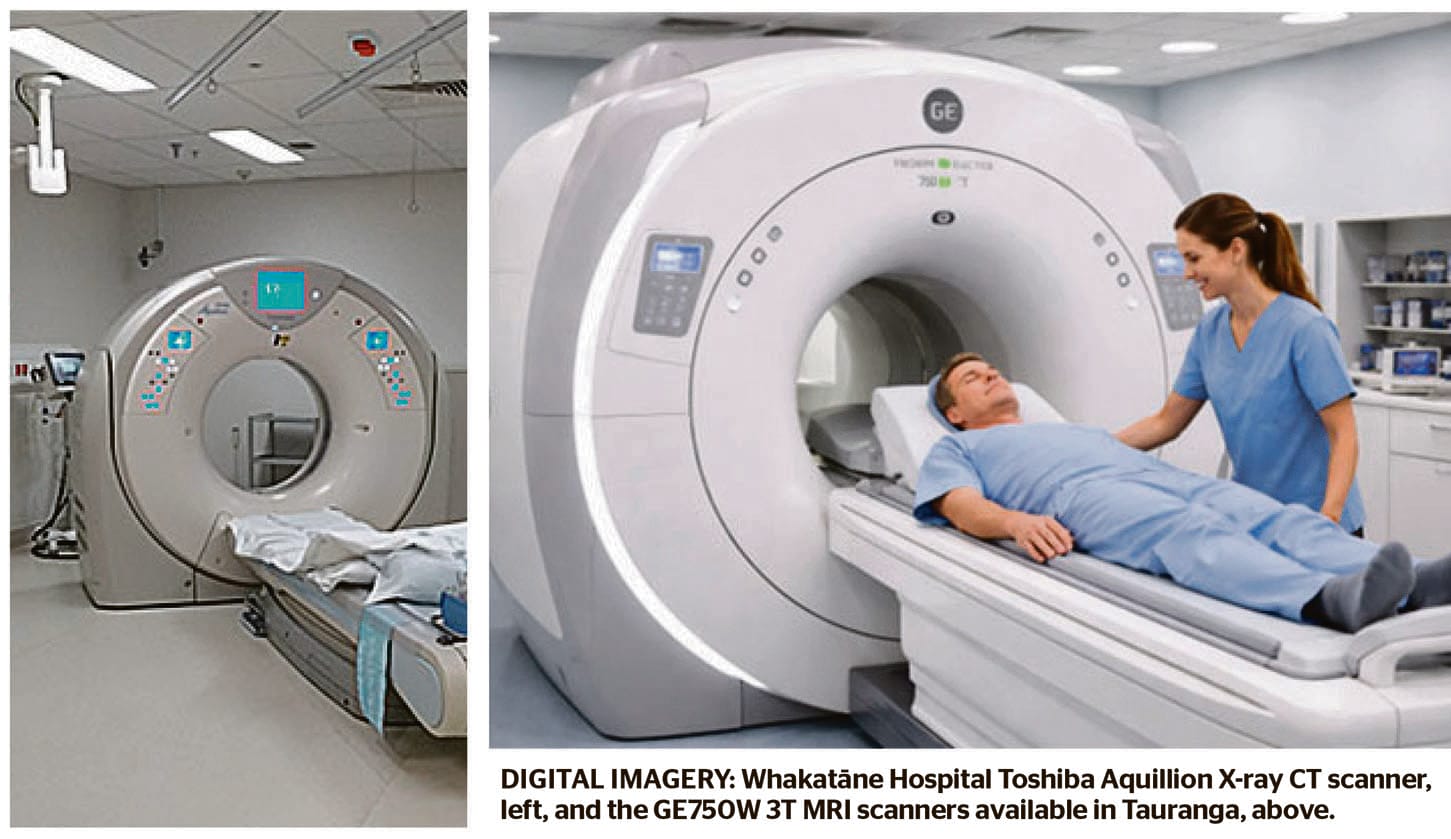
The first X-ray CT scanner (see image) was funded by Trust Horizon and was installed at Whakatāne Hospital and began operation on February 15, 2007.
That scanner was replaced with a new instrument in mid-2024. The new instrument was also funded by Trust Horizon. Since about 2020, Whakatāne Hospital has also been able to conduct cardio ultrasound imaging.
Whakatāne Hospital, which services the entire Eastern Bay, does not possess an MRI scanner. MRI is better than X-ray CT for imaging soft tissue. To get an MRI scan, EBOP patients have to travel to Tauranga.
Four MRI scanners are located at the private Grace Hospital campus. They are General Electric GE750W scanners that use 3 Tesla super-conducting magnets.
In 2021, I compiled a database of all diagnostic imaging modalities in New Zealand, who paid the capital cost of the equipment and who pays to operate them by lodging OIA requests to each of the 20 district health boards.
I also asked for data on patient throughput for each instrument. Incredibly, the Ministry of Health (MoH) did not have a complete inventory of the imaging equipment in the country and the data I wanted. It was a lot of work.
When I first compiled the data in 2021, Tauranga had four MRI scanners.
Today, Tauranga has seven MRI scanners. To the four scanners located at Grace Hospital were added another three located in Papamoa, Mount Maunganui and Elizabeth Street. Seven scanners for Western BOP and zero for Eastern Bay.
For six years I have been advocating for an MRI scanner for Whakatāne Hospital.
In January of 2021, I met with our elected member on the District Health Board for the second time and was told that a scanner was on the radar for Whakatāne.
I was also told that the scanner would be owned and operated by a private outfit, Bay Radiology. The scanner never arrived.
After making enquiries to hospital managers I was eventually put into contact with people who could help me figure out what was going on.
On June 19, 2024, Grey Power invited Bay Radiology’s operations manager, Sergio Fernandez, to speak to us about MRI and the plans to install an MRI scanner at Whakatāne Hospital. This would give Bay Radiology a monopoly in the BOP.
We were informed that the MRI scanner was due to be installed by November of 2024 and that preparations were under way.
At the time, the scanner was apparently sitting in a crate somewhere in Auckland.
November came and went and no scanner materialised.
After making more enquiries I was informed that the installation had been delayed until the beginning of 2025.
As the mayor at the time, I had meetings with several health authorities in 2025 and with the architect responsible for designing the building in which the scanner was to be housed.
I was told that there were problems with the earthquake fault that ran through the hospital campus. I was later told that the problem was one of finding an alternative location.
I was also told that there was some sort of dispute over the best use of the originally designated site. Difficulties in negotiating contracts was also mentioned.
The designated site was the first car park on the right just off Garaway Street as you head south.
On February 27 this year, Grey Power hosted the Minister for Seniors, Casey Costello, who came to speak to us about her Better Later Life Action Plan (2025-2028).
The plan addresses the priority areas of health, housing and cost-of-living. Ms Costello is also the Associate Minister of Health.
At the meeting she was asked about the status of the MRI scanner for Whakatāne Hospital.
She said that health wasn’t her portfolio and passed the buck to our East Coast Representative, Dana Kirkpatrick, to follow-up. To date, Grey Power has heard nothing from our MP.
On March 5, I wrote to the interim hospital manager to request an update. She eventually responded on March 23 that she couldn’t tell me anything.
On March 19, the Whakatāne Action Group independently wrote to Cath Cronin, Health NZ’s executive regional director for our area. They were told the following: “An agreement for a lease wasn’t reached and the MRI has been relocated to Masterton.
The MRI was owned by the private provider.
“Health New Zealand Te Whatu Ora will continue to work through options to place an MRI in Whakatāne.”
So, after waiting for two to three years, negotiations over lease and contract arrangements have broken down and the scanner, which had been sitting in a box for almost two years, was redirected to Masterton, a district with a smaller population than ours. That they are “exploring options” doesn’t sound very encouraging.
What does all this tell us about public-private partnerships?