
Filmmaker awarded scholarship
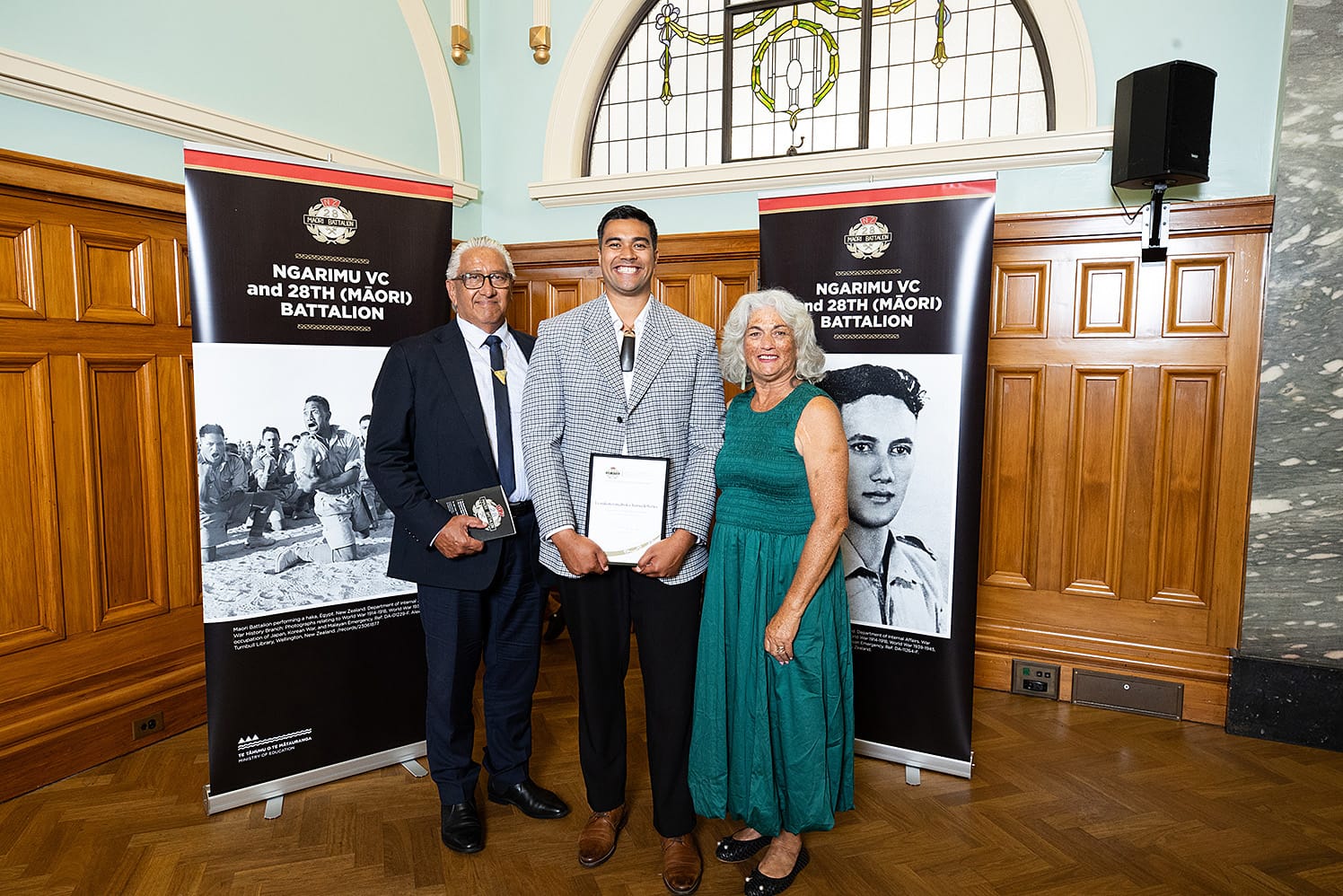
Proud: Uenuku Jeffries, centre, with his father Richard Tauehe Jeffries, and mother, Geraldine Paretakaka Jeffries, and after receiving his scholarship. Photo supplied
Aston Palmer
Ōpōtiki man Uenukuterangihoka Jefferies, a self-employed videographer and filmmaker with a young family, has been awarded the 28th Māori Battalion Memorial Scholarship.
Mr Jefferies is completing a PhD in documentary and filmmaking at Auckland University of Technology (AUT), Te Wānanga Aronui o Tāmaki Makaurau, , where he began his studies in May 2025. He has just over two years remaining in his research.
As part of his doctorate, Mr. Jefferies’ PhD research question is, “How might a Māori filmmaker approach the documenting of puhoro and its wider cultural contexts by drawing on knowledge and tikanga that have developed alongside the reclamation of pre-colonial ceremonies?”
He is answering this question by producing four short documentaries on his experience of Pūhoro.
Pūhoro is a traditional form of tā moko that spans the buttocks, lower back and legs. It carries deep spiritual significance and is often undertaken with the support of whānau and close connections.
He underwent the process in 2022, a five-day experience that involved stepping away from his Catholic upbringing and reconnecting with tikanga Māori.
Mr Jefferies grew up speaking te reo Māori and attended full immersion schooling. His parents spoke only te reo Māori to him and his five siblings, a deliberate decision that helped shape their identity and connection to te ao Māori.
His family moved to the Ōpōtiki region when he was young to be closer to his grandfather, James Hirini Richardson, a sergeant of the 28th Māori Battalion.
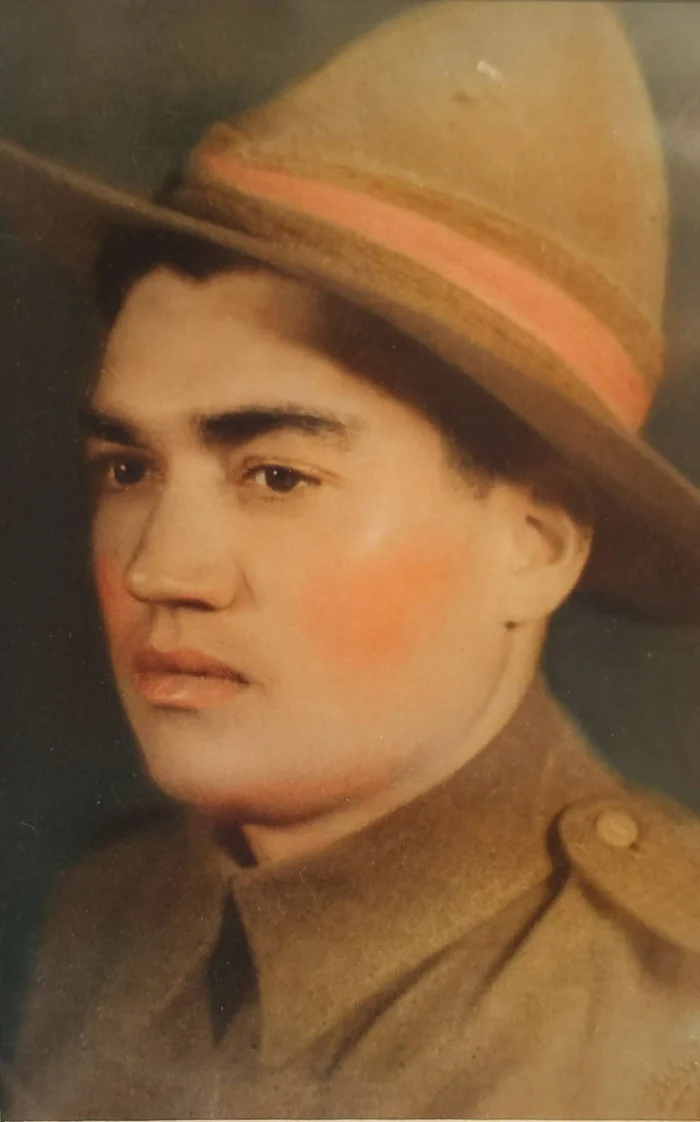
Mr Jefferies said receiving the scholarship strengthened his connection to his Papakoro, who passed away when he was eight years old.
He honoured that connection by speaking te reo Māori when accepting the scholarship, reflecting the language he shared with his grandfather.
Mr Jefferies spent much of his childhood with his Papakoro, often visiting after school and on weekends.
His mother, Geraldine Paretakaka Jeffries, recalled a story that reflected his pride in his mokopuna.
“He’d stop off sometimes on the way home and ask if he’d like to have an ice-cream, and of course, he would say yes. And they’d go into the shop, and the lady serving would ask, ‘What flavour would you like?’ And my father used to say, ‘Oh, you can’t speak English to him. He can only understand Māori.’ And my father was very proud of the fact that he could speak only Māori.”
The 28th Māori Battalion Memorial Scholarship is awarded to descendants of Battalion members, with recipients selected by descendants and past winners. There are 12 scholarships awarded each year, with only one designated for a PhD recipient.
The PhD scholarship is valued between $20,000 and $40,000 over one to two years, helping cover course-related costs.
Mr Jefferies is so grateful to the C Company representative, Dr Kahurangi Waititi, as well as the Ngarimu VC and 28th (Māori) Memorial Scholarship Fund Board for selecting him to be the recipient of the scholarship.
Mr Jefferies’ parents said they were incredibly proud of their son, though initially surprised by his decision to pursue a PhD.
“It really surprised me. Because Uenuku found it difficult academically. He had to work really, really hard to keep on his pathway. And when he said he was going to do his PhD, well, that really struck me,” Mrs Jeffries said.
Mr Jefferies acknowledged the support of his supervisors at AUT, including Dr Marcos Mortensen Steagall, Dr Welby Ings and Dr Hinematau McNeill, who are guiding him through his research.
He said returning to study has helped him grow as a filmmaker and refine his craft, and he is grateful to the 28th Māori Battalion representatives for awarding him the scholarship.
For Mr Jefferies, the scholarship represents more than academic achievement. He said it is about remembering his Papakoro and ensuring the legacy of the 28th Māori Battalion continues through his work and future generations.
“Their voice lives on in us, and they’re not forgotten,” he said.
Through his documentaries, he hopes to preserve and share tikanga Māori in a way that not only tells his story but reflects the wider experiences of whānau and the enduring strength of te ao Māori.