
Kiwi farmers admired globally
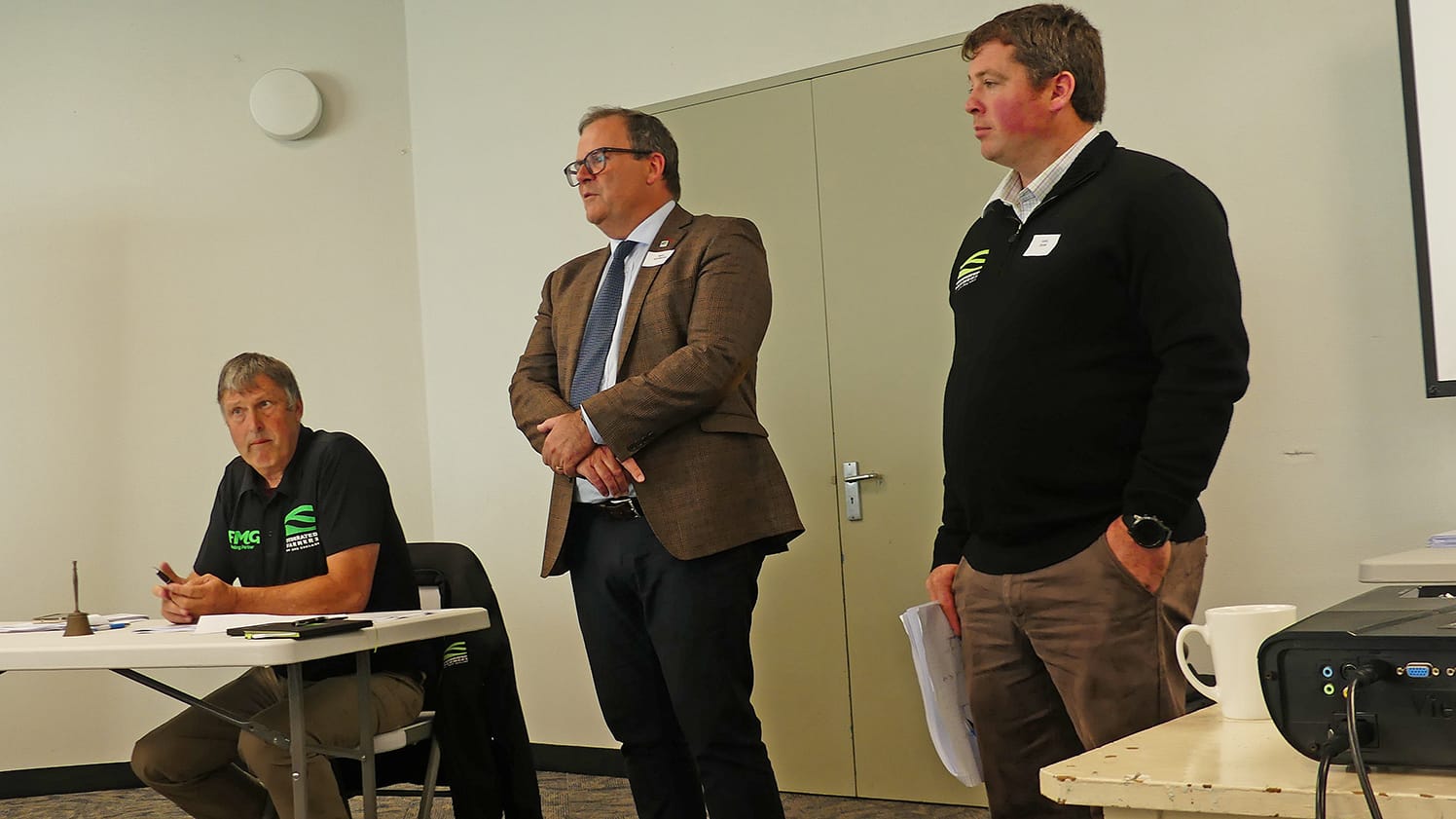
SPEAKERS: Bay of Plenty Federated Farmers president Brent Mountfort, Mike Siermans and Karl Dean.
.
Sven Carlsson
SPEAKING to the 70 people attending the Bay of Plenty annual meeting held in Edgecumbe on Monday, Federated Farmers chief executive Mike Siermans said he was impressed.
“This is the biggest AGM I have attended – and I have been to several over the past few weeks,” he said.
“It’s also the first where they ask you if you want red or white wine.”
Bay of Plenty Federated Farmers president Brent Mountfort had just opened the meeting, welcoming the speakers and the life members, standing next to the line of neatly packaged wine bottles that were to serve as a “thank you” to the speakers.
Having been in the job for six months, Mr Siermans said he wanted to increase the Federated Farmers membership from 12,000 to 14,000.
“Advocacy is our game – across the local, regional and national policy levels,” he said.
“We are a fraternity; think of the collected knowledge in this room.”
Mr Siermans said he also stood for fiscal responsibility, that he wanted to hold the Government to account and “give them more guidance”.
“We need to put confidence back into farming,” he said.
Federated Farmers dairy industry chairperson Karl Dean said it was time to “get rid of one layer” in the local government structure.
By moving the responsibilities currently held by regional councils to the appropriate municipal and rural councils, a more efficient structure could be reached.
Mr Siermans said it was about “getting the structure right – not the people”.
“We have good systems and good people; what is the right structure?” he said
“The complexity needs to be reduced.”
Mr Mountfort said the farmers in the Bay of Plenty had a good relationship with the regional council – “we don’t want to lose that.”
Mr Siermans said the key functions of the Federated Farmers was the fraternity, which provided solutions, understanding and connections, working with the partners, and finally being able to offer support during adverse events.
“We can give you a call about what goes on, on the ground, and we can mobilise support,” he said.
“We want to increase productivity and increase the amount of export dollars.”
Lincoln University adjunct professor Jacqueline Rowarth said she was “a practical scientist – not one working on assumptions”.
“My role as a scientist is to listen to information, then decide if this is factual or fiction,” she said.
This detective work includes determining the worth of data presented as fact.
Dr Rowarth showed two examples of extraordinary data correlation, which she leaned towards disbelieving even though they were impressive.
The first was how “per capita cheese consumption” over the years 2000 to 2009, closely matched “the number of people who had died by becoming entangled in their bedsheets” over the same time period; the second was how the “divorce rate in Maine” matched the “per capita consumption of margarine” over the same time period.
Dr Rowarth said the first role of the food system was to feed a growing number of people – not to decrease greenhouse gases.
“We must increase productivity and resilience,” she said.
“New Zealand farmers and growers are admired globally for what they achieve and the fact that this is achieved without subsidies”.
The New Zealand primary industries were doing well, showing steady growth and only eight percent of the populace thought farmers were bad for the country, she said.
New Zealand imported almost half of its food, including coffee, chocolate, bananas and pineapples.
While there were people leaving New Zealand for elsewhere, Dr Rowarth pointed out that New Zealand topped global HR solutions provider Remote’s Global Life-Work Balance Index 2025 for the third consecutive year because of its 32 days’ annual leave, 26 weeks’ paid maternity leave, and high safety/happiness.