
Workshops offer guidance on Māori Land Court processes
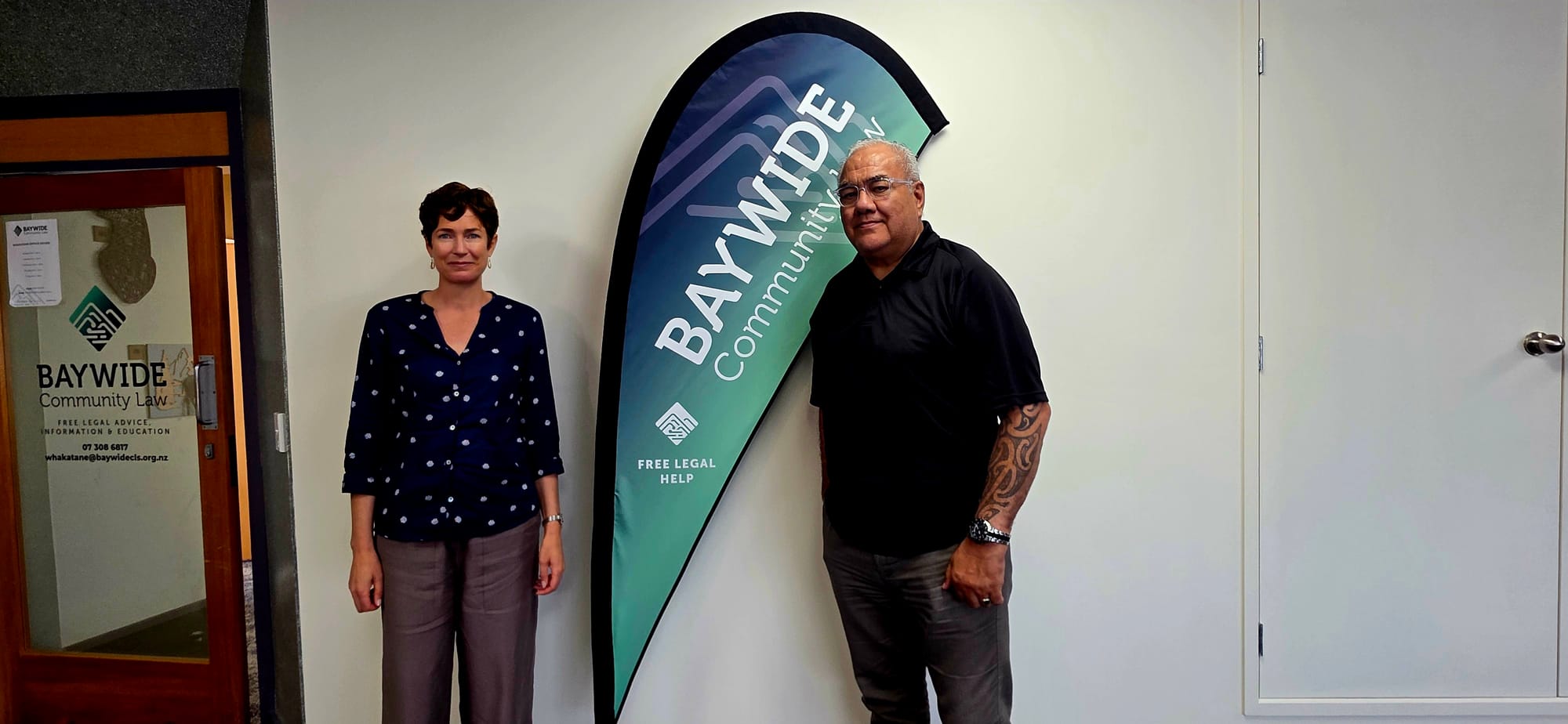
WHENUA WORKSHOPS: Baywide Community Law practice manager Fiona Joyce and Te Kooti Whenua Māori Pae manawa Jimi McLean provide practical guidance for navigating Māori Land Court processes. Photo supplied
Tamara Herdman
Eastern Bay of Plenty whānau are being encouraged to attend monthly free Whenua Māori workshops aimed at helping trustees, landowners and beneficiaries better understand Māori Land Court processes and their roles and responsibilities.
Hosted by Baywide Community Law and presented by Te Kooti Whenua Māori, the workshops provide practical guidance on how to engage with the court and navigate applications relating to whenua Māori.
The next Whakatāne workshop will be held on Tuesday, May 12 at Baywide Community Law, Level 2, Niederer Plaza, 195 The Strand, from 10am.
The kaupapa for the upcoming May session is Māori Land Court processes and procedures, with a focus on supporting whānau to confidently work through the system.
Te Kooti Whenua Māori workshops are delivered across the wider Eastern Bay, including Whakatāne, Ōpōtiki, Kawerau, Murupara and Te Kaha, to ensure accessibility for rural communities.
Attendees can also book one-on-one kōrero with Māori Land Court Kaimahi for more specific guidance relating to their whenua.
Jimi McLean, pae manawa for Te Kooti Whenua Māori, whose role focuses on iwi and cultural engagement, said the workshops were designed to make legal and governance information more accessible.
“We provide these workshops to give whānau an opportunity to gain a better understanding of Māori land systems and trustees’ decision-making responsibilities.”
Topics covered include Māori land governance, succession, court processes, the role of a trustee and trust structures.
Mr McLean said the sessions were intentionally interactive, encouraging discussion rather than formal instruction.
“It is an open discussion as opposed to me standing up there teaching. For us to be able to learn from each other, we need that reciprocal kōrero.”
The workshops also help clear up common misconceptions. During the last session, an attendee queried why they were still listed as a trustee. It was explained the Māori Land Court relies on information being provided, such as updated trust deeds, and may not be aware of changes unless notified.
Scenarios are used during sessions to explore real-life decision-making, including balancing social and economic outcomes for whenua.
Mr McLean said trustees are often required to weigh up competing priorities.
“We look at scenarios that trustees might face, weighing up things like affordable housing for whānau against economic return from the land, balancing the needs of our people.”
One example explored a whenua block planted with kiwifruit returning around $100,000 annually across 200 beneficiaries.
“If trustees choose to use part of that land for housing, the income could drop significantly. These are the kinds of decisions trustees need to make.”
He said ultimately trustees must make decisions in the best interests of beneficiaries.
Tikanga Māori principles such as kaitiakitanga are a key part of the discussions.
Mr McLean acknowledged the role of community partners in making the workshops possible.
“Without the support of organisations like Baywide Community Law, Heartlands in Ōpōtiki, Kawerau and Murupara, and Apanui Justice in Te Kaha, our ability to get out into the community would be limited. They provide the space, time, energy, and a cup of tea, manaaki for our people.”
Baywide Community Law kaihāpai hapori/community connector Te Aokahari Niao said their organisation was committed to improving access to legal information across the region.
“We’re here to help the community not only with Māori land matters, but also with employment, family and criminal matters and many other issues,” he said.
“We work closely with whānau across the Bay of Plenty, often going out to marae and community spaces to make sure people can access support without having to travel.”
He said the workshops were part of a wider effort to reach underserved communities.
“We’re trying to take services out to where people are,” Mr Niao said.
For more information, or to register for the May 12 workshop, contact 0800 905 916 or email [email protected].