
Ironsand brings back memories
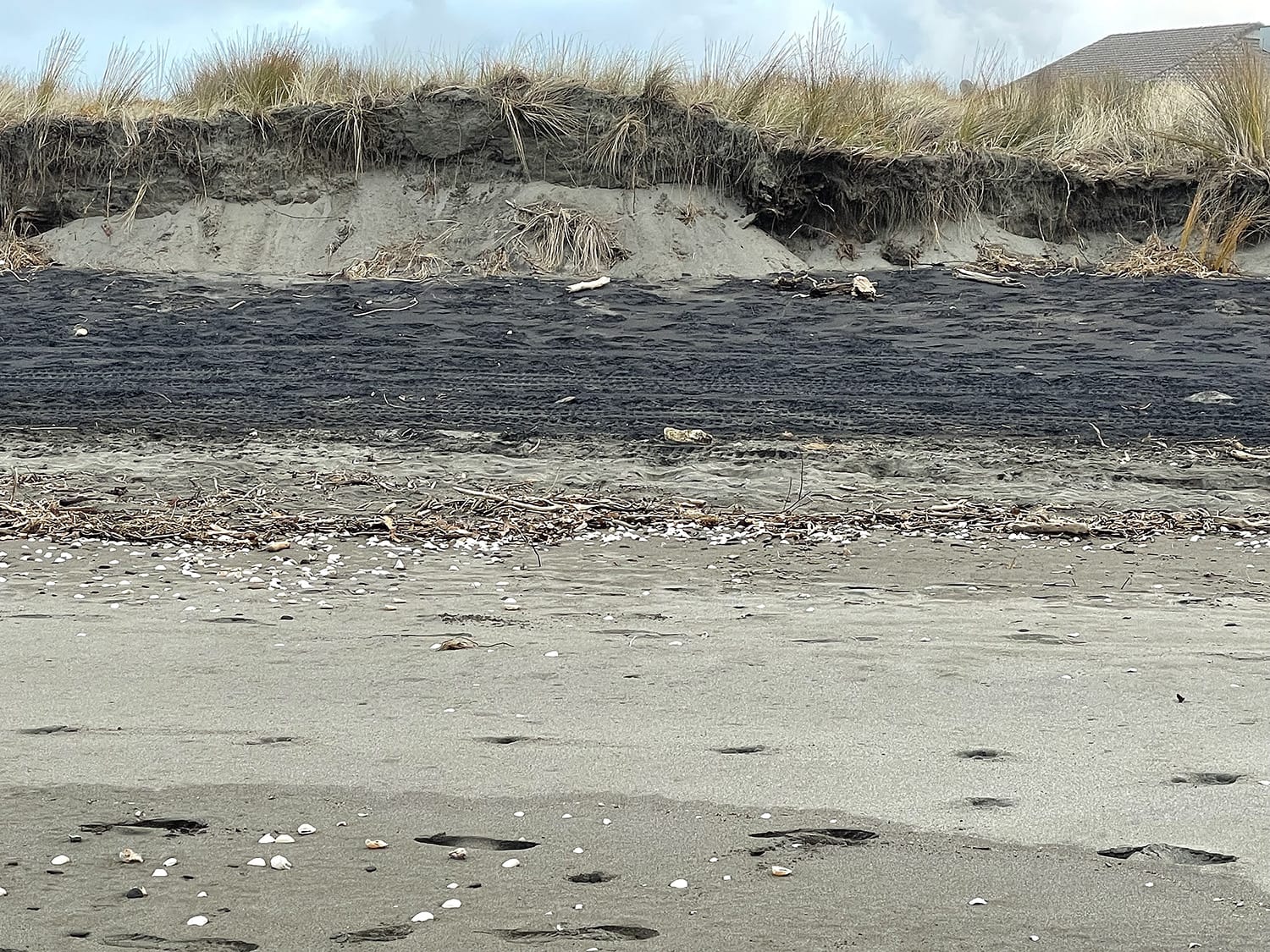
DARK LINE: When first washed up earlier this month, the ironsand formed a neat line hard up against the dunes. Photo Karen Richardson
Paul Charman
Some of us who grew up visiting North Island ironsand beaches were fascinated to see a narrow band of this black material neatly tossed up along the Ōpōtiki seafront.
For me, the narrow strip of black sand along the coast last week recalled painful barefoot escapades, scuttling across Taranaki beaches during summers long ago. If you’ve walked barefoot across West Coast beaches in direct sunlight, you’ll understand.
The Ōpōtiki deposit lasted about a week before wind, waves and driftwood scattered it, but though rare, this phenomenon is not unknown locally.
The Bay of Plenty has several ironsand deposits; relatively small ones compared to the millions of tonnes along the West Coast.

More’s the pity.
Ironsands have been a lucrative export earner for this country since the early 1970s, main extraction sites being:
n Close to the Waikato River mouth, where ironsand is dredged up to be turned into pig iron in the smelters of Pacific Steel, Ōtāhuhu.
n A larger deposit a few kilometres south of Kāwhia Harbour, where sand is removed from dunes by the reclusive Taharoa Ironsands.
At the latter site about 90 minutes’ drive west of Ōtorohanga, this operation had paid more than $150 million in royalties to iwi landowners between 2017 and 2023.
Sand is processed using magnetism then mixed with water to form a slurry pumped through underwater pipes to a swing-berth 3.5km offshore.
There is no natural harbour at Taharoa, so big ships braved rough coast coastal waters to moor at the tie-up, where their holds are filled with iron-rich slurry. They then carry it to China or Japan.
It’s a fascinating process never seen by the public.
In this regard it is noteworthy, at least to me, that this area of the Waitomo District recently gained international attention for being close to where Marakopa dad Tom Phillips went missing for almost four years.
Apparently, Mr Phillips used remote bush camps to hide from police with his three children. Mr Phillips died in a shootout with police near Piopio last September, after which his children were taken into care.
During the first three years of this case, I was a reporter at the local newspaper, The King Country News, where my colleagues and I were assured by sources on the Coast that locals knew where Phillips was hiding.
True or not, nobody would say more.
Of course, there is no connection between the late Mr Phillips and Taharoa Ironsands I mention it merely as an indication of how isolated the scene of this private sand extraction operation is.
Probably two biggest stories from my time at the King Country News were similar in that I could find no locals from this coastal area prepared to comment on them.
Taharoa Ironsands was a story, I would have thought a positive one, when it applied to the Waitomo District Council to expand operations.
My request to see the multi-million-dollar operation was declined and no comment was forthcoming from owners, employees or neighbours.
The newspaper received anonymous rumblings on this or that aspect of the business, but nothing concrete.
I’d still like to see Taharoa Ironsands and, if ever it has an open day, I’d be tempted to drive across this island.
As of 2023 the mine operated 24-hours-a-day seven-days-a-week, with a 10-hour maintenance shutdown every fortnight, on a Wednesday.
It employed about 180 operational staff plus additional contractors. About 80 percent of mine workers were locally based Māori (Ngāti Mahuta), and 63 percent of skilled roles filled by Ngāti Mahuta.
Most employees lived either permanently or temporarily (during working days) in the nearby Taharoa Village, where Taharoa Ironsands owned 75 houses, letting them to employees at a discounted rate.
The company also owned and maintained the community hall, school, shop, two large sports facilities and the fire brigade. It provided a bus service, subsidised freight to the village store and had two helicopters on standby for emergencies.
Taharoa Ironsands maintained the infrastructure supporting the village, including water, wastewater and rubbish collection. It provided an education payment for travel and boarding for employees’ high school-aged children, at a cost of up to $18,000 per child annually.
It all sounded to me like something out of Western Australia, but unlike the flush Aussie mining towns of Port Hedland, Dampier or Onslow – this place chose to operate entirely under the radar.