
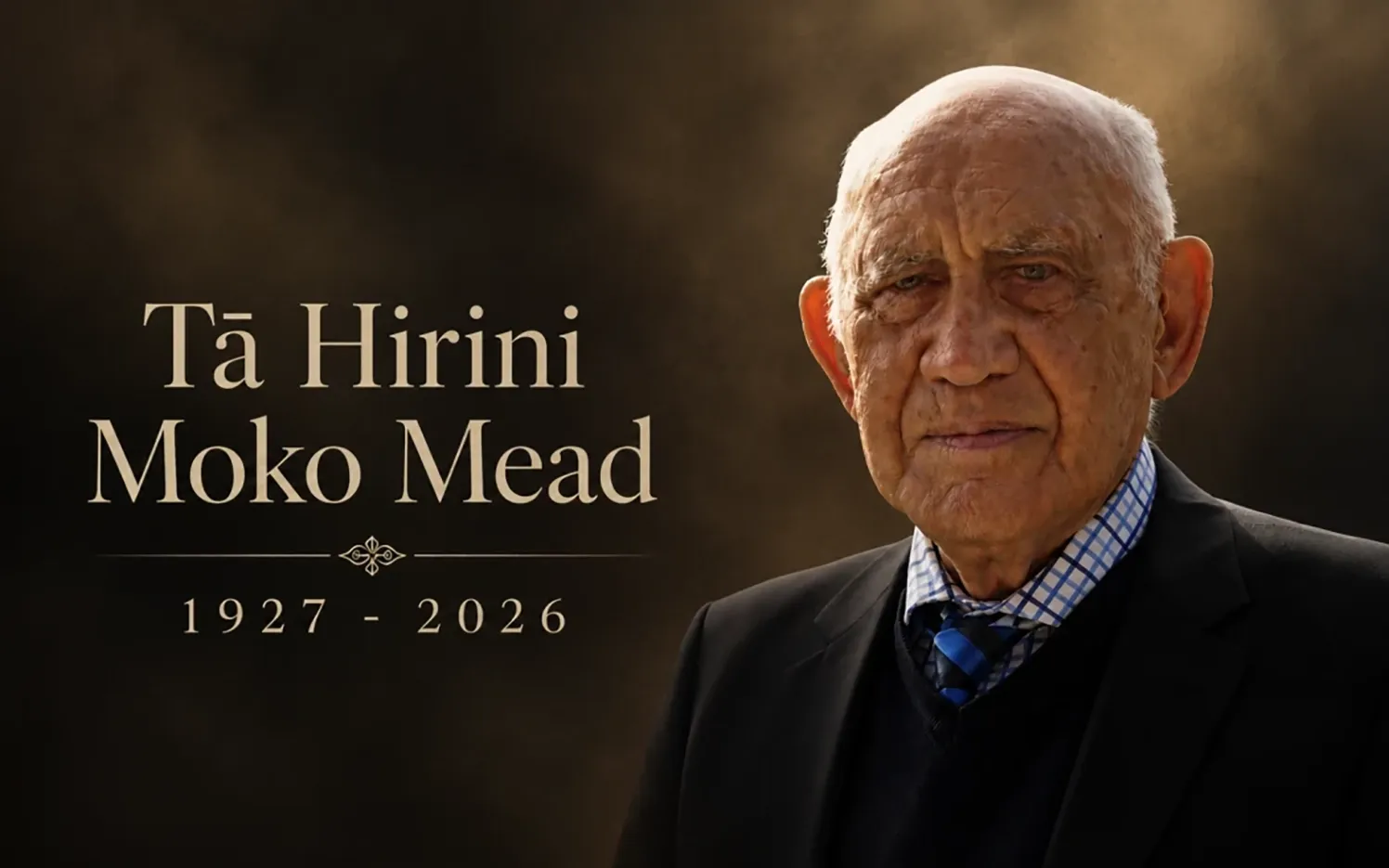
Tā Hirini Moko Mead – pillar of strength laid to rest
.
RNZ
Hundreds have gathered at Kokohinau Marae in Te Teko over recent days to farewell one of Māoridom’s most influential leaders, Tā Hirini Moko Mead.
The respected Ngāti Awa rangatira, scholar, author and champion of te reo Māori died last Friday, aged 99.
After lying in state at his marae while whānau, iwi leaders, academics and admirers paid their respects, Tā Hirini was laid to rest yesterday morning following a 10am karakia.
Among those reflecting on his life is Ngāti Awa leader Joe Harawira, who said the outpouring of aroha was a testament to a man whose influence extended far beyond his own iwi.
“He was so much more than an academic and a leader. He was more than a public figure. He was a dedicated teacher, a vigilant guardian of mātauranga Māori, a steadfast champion of the survival of te reo Māori and his enduring commitment to his people was evident in everything he did.”
Speaking to RNZ’s Māpuna, Harawira said one of the greatest strengths Tā Hirini possessed was his ability to unite people.
“No matter how heated the discussion became, people could be head-to-head, but he would always stay calm and bring the focus back to what the original goal was.
“It was an admirable quality and one that helped him bring people together.”
That ability to find common ground was reflected in one of the final kaupapa he shared with his people before his death.
Harawira was among those attending a hui where Tā Hirini was outlining the first phase of an initiative he called “Hohou i te Rongo” when he died.
“Hohou i te Rongo was his kaupapa and it was essentially a process of engaging with iwi across Mataatua waka and talking to each other directly with a focus on putting any differences aside to work towards a common goal.”
Harawira said the whakaaro had developed over several years and was partly informed by issues that emerged through Treaty settlement negotiations.
“Ngāti Awa was the first iwi to settle because we wanted to focus on building capability amongst our people. There were land issues that we put to one side at the request of neighbouring iwi such as Whakatōhea and Tūhoe.
“When those iwi settled we found our settlement had effectively shrunk because of overlapping interests in Ngāti Awa whenua.”
Rather than allowing those differences to continue, Tā Hirini believed iwi should sit down together and work through them.
Over recent years he had identified five iwi he believed Ngāti Awa should engage with through a formal “Hohou i te Rongo” process.
“He gave me five iwi that Ngāti Awa needed to approach and just last year he said to me, ‘Joe, I hope to be alive to see one of these kaupapa come to fruition’.”
The hui Tā Hirini was leading marked the beginning of that journey.
“We had gathered to get his guidance and understand his whakaaro on how we would carry out that process. It was going to become a template for engaging with the other iwi and implementing this kaupapa more broadly.”
Harawira said Tā Hirini was outlining what he believed was the best approach for the first engagement when he passed away.
For those closest to him, there is comfort in knowing his final days were spent doing what he had done throughout his life – serving his people and working towards a stronger future for coming generations.
He achieved so much with humility and grace. Everything he touched was about uplifting people, building capability and strengthening mana motuhake.
“The kaupapa was his dream. Now it’s up to us to make sure it happens.”
Organisations Tā Hirini helped build, strengthen and inspire carried the important responsibility telling his story on his behalf.
Tā Hirini and his contribution to education, language revitalisation, tribal development and mātauranga Māori is widely recognised. Those working within New Zealand’s legal system say his influence helped transform the way tikanga is understood and applied today.
Māori Land Court judge and Waitangi Tribunal member Judge Alana Thomas said Tā Hirini dedicated much of his life to ensuring tikanga Māori would not only survive but continue to guide future generations.
“Nā Pāpā Hirini i tīmata te kaupapa o Te Pourewa Tikanga ki te Ture i roto i Te Whare Wānanga o Awanuiārangi. He kaupapa hei āwhina i te hunga kaiwhakawā kia mārama ai ki te whānuitanga me te hōhonutanga o te tikanga me tana whai wāhitanga ki te ao ture.”
Through Te Pourewa Tikanga ki te Ture at Te Whare Wānanga o Awanuiārangi, Tā Hirini created opportunities for judges to deepen their understanding of tikanga Māori and its place within contemporary legal practice.
Judge Thomas told Pūkāea News his work will ensure future decision-makers better understand Māori values, perspectives and responsibilities.
For her, however, the true legacy of Tā Hirini extends far beyond any single institution.
“Hāere te wā, hāere te wā, ko tēnā te āhua o āna mahi katoa. Ko te Rōpū Whakamana i te Tiriti, āna tuhinga, āna pukapuka hoki, kua āwhina i te hunga ture kia kitea he huarahi mō te tikanga i roto i te ture.”
His work with the Waitangi Tribunal, alongside a lifetime of writing, teaching and advocacy, helped create space for tikanga Māori to be recognised, respected and understood across Aotearoa.
Those who knew him best say it was not his titles, achievements or accolades that defined him.
For Judge Thomas, Tā Hirini embodied the very essence of rangatiratanga.
“Tērā tangata e arohanui ana ki tana iwi, e ārahi ana i tana iwi, ā, e arohaina nuitia ana e tōna iwi. Ehara tana whakaaro mōna anake, engari mō tōna iwi whānui.”
He was dedicated to his iwi, he was a champion for his iwi, he never put himself first and his people loved him for it.
She said his leadership was grounded in service to others and an unwavering belief in Māori potential.
“The overwhelming feeling I carry is his deep love for Māori and his steadfast belief that we are a people of great dignity and strength.”
As whānau, iwi and communities honour him, the organisations Tā Hirini helped build, strengthen and inspire are now carrying out an important responsibility on his behalf.
Mataatua institutions Tā Hirini helped shape are clearly reflecting the impact of his work as they take back control of their own narrative and safeguards the stories of their people.
– RNZ