
Opotiki is Rising: Visualise a flood-resilient historical Ōpōtiki as a district service centre
Ngaire Tai
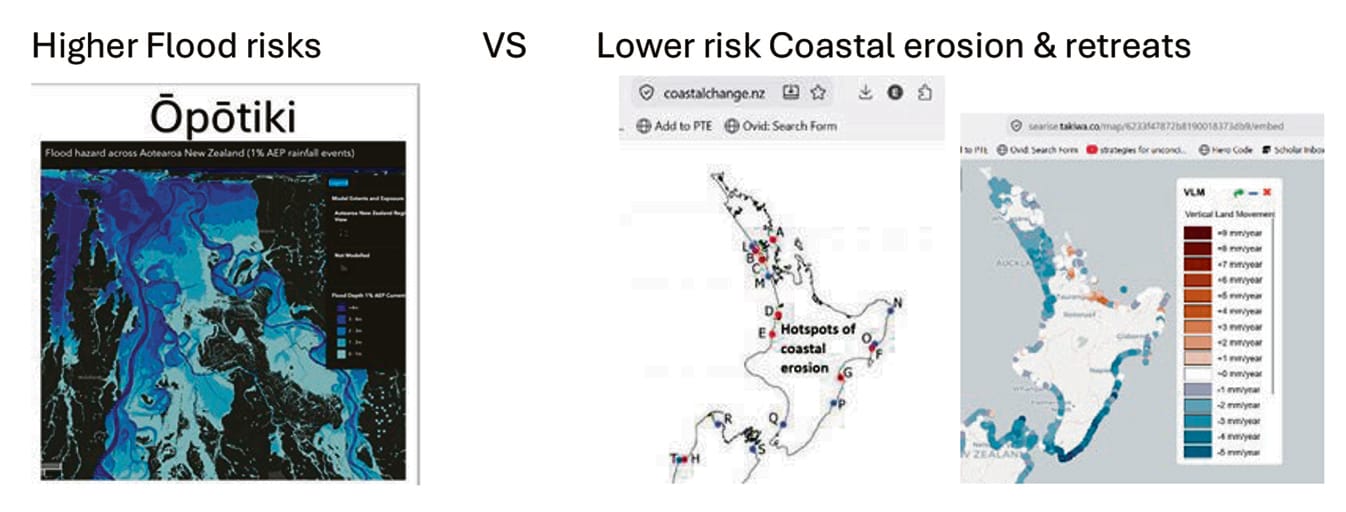
NIWA modelling is clear
We know Ōpōtiki whānau and community are right to face flood risk honestly.
Climate change means more frequent and deeper flooding, particularly where rivers, tides, and storm surges combine.
Positively, though, our coast region has the most Vertical Land Movement in the North Island.
Our land is raising us upwards, which reduces the risk of erosion-driven land loss with coastline retreat. This may explain the acceptable hazard risks for the recent Waiōtahi Drift expansion, despite flood risks.
The dominant risk Ōpōtiki faces is flooding and inundation, not the disappearance of the township.
Flooding is serious and costly but it is a challenge many towns have learned to live with through adaptation, elevation, and resilience, not abandonment.
■ Hukutaia Expansion is logical and necessary
At the same time, Ōpōtiki needs a supply of good homes, population growth, and economic momentum that enables whānau and community to flourish.
The Ōpōtiki District Council (ODC) Long-Term Plan acknowledges, briefly, that housing growth in Hukutaia supports “business growth and jobs” (p.22). Beyond that line, however, there is little clarity about what those jobs are meant to be, where they are located, or how the town functions to support them. This matters.
■ Historical Ōpōtiki as a vibrant “district service centre”
The ODC Long-Term Plan repeatedly describes an aspirational “district service centre” (pp.22, 138-139) while simultaneously adopting a strategy of “pulling back” services and deferring investment in its early years (pp.163, 167). Those positions sit in tension.
A service centre cannot exist in name alone. It must be physically, economically, and socially supported.
Whānau, hapū, iwi and communities of Ōpōtiki also live with the impacts of a nationally significant history shaped by colonisation, land loss, and enduring inequities.
Contending with this history is a responsibility that cannot be ignored. Without deep attention to our history, injustices in new forms risk being repeated and opportunities are missed.
Together with our harbour, trails, coast, and landscape, our history offers a unique foundation for ecocultural tourism in a heritage township.
Truth telling, Mātauranga Māori, outdoor pursuits, and wellbeing reinforce one another.
As a district service centre, Ōpōtiki should plan for well paid, locally anchored service jobs, grounded in an understanding of our historical context: medical and physical rehabilitation, drug and alcohol recovery, secure dementia care, hospice services, dialysis, rural health teaching, and centres of excellence in Māori rongoā and traditional medicine.
These are the services rural regions struggle to access, and these services depend on a stable, trusted town centre.
■ The injustices of caution
Yet, many residents feel the township is being treated as a risk. When investment is reduced in the town and redirected elsewhere, people naturally ask who benefits.
Even if there is no issue, that perception becomes a loss of trust. And, once trust goes, investment follows.
In small markets like Ōpōtiki, confidence is not abstract. With property values around $534,000, well below the national average and falling recently, signalling matters: a town perceived as being withdrawn from does not attract reinvestment. It sheds it.
Reduced owner-occupier home investment leads to increased rentals.
In the New Zealand context of no rent control, no requirement for long- term residential leases, and relatively light treatment of capital gains from property, rental dominance can destabilise communities quickly, especially when landlords live elsewhere and tenants lack security.
A hollowed-out centre with most of the population in rentals under absentee ownership, declining services, and growing isolation risks repeating historical injustices.
Independently wealthy or retired residents enjoy the landscape but travel elsewhere for healthcare, education, and work.
The town remains inhabited, but economically fragile. This irresponsible vision is not inevitable.
A district services and town centred resilience strategy is urgently needed.
Decline is not inevitable; commitment is opportunity
Ōpōtiki could actively back affordable home ownership, not just housing supply. That means incentivising flood resilient, climate responsive, and retrofits (eg, elevated, Queenslander style homes, adaptable ground floors, “sponge” landscaping). Thus, existing residents are supported to stay, invest, and belong. Flood resilience becomes an enabler of stability, not a pretext for withdrawal.
■ Transparency matters
Residents, however, notice inconsistencies. After devastating floods in the 1960s, Ōpōtiki joined the national shift toward flood protection, using stop banks to adapt rather than abandon the town.
Today, stop banks, pumps, and state housing are funded in flood affected areas, yet there is no equally clear strategy for adapting the wider township.
As many owners receive developer offers to buy, it is reasonable to wonder whether an unspoken vision now advantages low-risk, ratepayer-funded growth areas while concentrating risk for town residents.
Good planning avoids not only conflicts of interest, but the appearance of them. Ōpōtiki’s challenge is not that growth is happening in Hukutaia. It is that the town is not yet being treated as infrastructure essential to that growth.
The current strategy minimises how much the township must be actively held together for growth to succeed.
Flood risk is real. Adaptation is necessary. Growth is essential. Flood resilience should not be used to justify quietly relocating Ōpōtiki’s social and economic heart away from the township, while public resources are redirected toward low-risk greenfield developments benefiting a small number of landowners.
Ōpōtiki deserves an open conversation about what kind of town we are planning for.
■ The Vision
We believe in a flood-resilient Ōpōtiki historical township that remains lived in, invested in, and economically alive for generations to come. Such a place may heal past injustices, build wellbeing through care and knowledge, sustain owner-occupied homes, and turn growth into lasting prosperity.
That is the future we should be visualising, and investing in, together.
Let us all share our visions for a vibrant, historical Ōpōtiki township. Indeed, whānau, hapū and community members can do this through the recently announced “Ōpōtiki Rising: Your Voice, Our Future”, two-month engagement series our Ōpōtiki District Council is organising.
Ōpōtiki is rising indeed. Our whenua land is lifting us herself through our Vertical Land Movement. We must also rise as a community, with a strong vision for our historical Ōpōtiki township.
■ Nāku iti nei, nā, (list authors)
Emily Gill, Ema Williams, Sally Kibblewhite, Lynne Dempsey, Ivor Jones, Sharon Craig, Dido Eden, Sandra Gee, Leelyn Ruwhui