
Opinion: GST on rates - the tax we forgot to question
.
David Hick
Every year, ratepayers open their rates bills and focus on the total at the bottom of the page.
Few stop to ask a simple question:
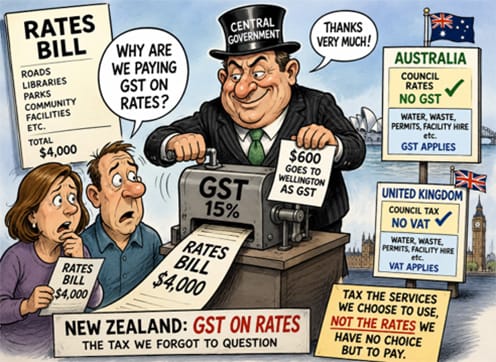
Why are we paying GST on rates?

Local body reform is being imposed on us, hopefully with the aim of saving money.
At the same time, the Government is proposing to cap annual rate rises to 2-4 percent. Most would say, about time. So, if we are serious about reform, then maybe the GST on rates should also be removed.
Done together, these changes would avoid any unintended windfall effects during the transition.
Most people understand GST when they buy goods and services. Buy a coffee, pay GST. Buy a lawnmower, pay GST. Hire a hall, pay GST. You’re purchasing something, even if you later regret purchasing it.
Rates are different.
You don’t choose them. You can’t shop around. You can’t “wait for a better deal next week” or quietly return them if you’re not satisfied.
Rates are a compulsory charge imposed by local government, in effect, a tax dressed up in paperwork and confidence.
Yet, Central Government adds 15 percent GST on top, meaning every rates increase also delivers additional tax to Wellington. Conveniently efficient.
The Government argues this GST is effectively recycled back to local government through funding streams and support mechanisms.
On paper, it’s a tidy circular system …. like sending a cheque to yourself and keeping a handling fee for the privilege.
In reality, every loop has friction: administration, compliance, redistribution, and a fair amount of paperwork that seems to multiply when observed. That means a portion of what is collected is consumed by the system itself, not returned in full.
Internationally, approaches differ. In Australia, local council rates are generally exempt from GST. In the United Kingdom, council tax is not subject to VAT.
These systems do not avoid user charges for water, wastewater, permits, and similar services still attract GST or VAT. The distinction is that the compulsory property charge itself is not taxed.
New Zealand stands apart by applying GST to the entire rates bill.
For a household paying $4000 in rates, more than $500 goes to GST. On a $5000 bill, it exceeds $650. That’s before you’ve even argued with your insurance company, replaced the hot water cylinder, or discovered the supermarket receipt has developed a personality of its own.
Meanwhile, local government is steadily shifting toward user-pays funding water charges, building consents, venue hire, boat ramps, dog registrations, and more.
Most people accept GST on these services because at least you’ve actively chosen to participate in the transaction.
Rates are not like that.
They are a compulsory contribution based solely on property ownership, a sort of national subscription service you didn’t sign up for but somehow can’t cancel.
If councils are moving toward user charging, it is reasonable to question whether GST should continue to apply to rates at all.
Removing GST from rates would not reduce council revenue. Councils would still receive the same funding.
The difference is that Central Government would collect less tax and would no doubt miss it terribly, at least for a few minutes, remembering, of course, that with inflation their GST take just keeps increasing automatically, including, eventually, GST on that $500 or so dollar saving when it escapes your pocket, the difference being you control its destiny.
At a time when affordability and cost-of-living pressures dominate public debate, this is an obvious place to look.
Instead of layering rebates and relief schemes over the top, why not remove the tax at source? Simpler, cleaner, and far fewer forms involved, which alone may be reason enough.
Ratepayers are told rising costs are unavoidable. Perhaps they are. But GST on rates is not.
Australia manages without it. The United Kingdom manages without it.
Maybe it is time New Zealand did the same.
If we’re all being asked to buy into local government reform, perhaps Central Government should throw something into the deal as well. Removing GST from rates would be a good start.
Tax the services we choose to use. Not the rates we have no choice but to pay.