
Mussel closure sought to refill food basket
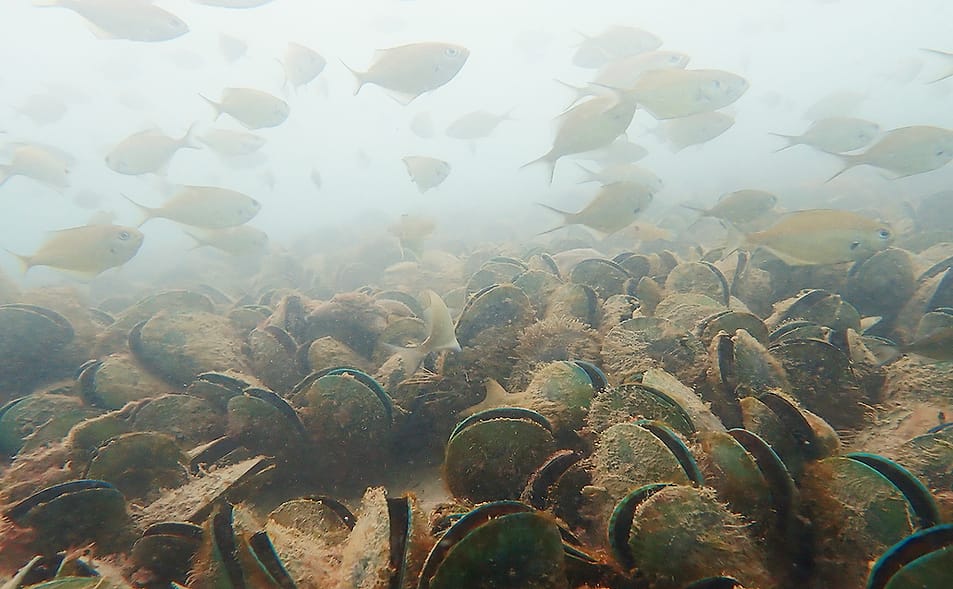
Regenerating: Green-lipped mussels bedded in Ōhiwa Harbour. Photo Kura Paul-Burke
Diane McCarthy
A sharp decline in Ōhiwa Harbour mussel stocks has led Te Rūnanga o Ngāti Awa to embark on a regeneration programme that is beginning to show signs of success.
The iwi is seeking a further two-year extension to a temporary green-lipped mussel harvesting closure established in November 2024 on an area of the harbour that is the focus of its work.
The harbour is known by local iwi as Te Kete o Tairongo, the food basket of Tairongo, as it once held kaimoana in abundance. Scallops, oysters, cockles, pipi, and many fish species are still harvested but many of these species are declining.
“Around 30 to 40 years ago mussel were prolific in Ōhiwa Harbour,” said Ngāti Awa customary fisheries officer Charles Bluett.
Research undertaken by the iwi, showed poor water quality and human predation had taken their toll on the shellfish, but it was the proliferation of another predator species, the 11-armed sea star (Patakaroa), that was identified as the biggest problem.
“The main reason [for the decline] we came up against was the sea star, so if we were to leave it to nature to take its course, we may take a century to get back to where we were,” Bluett said.
The work programme the iwi embarked on five years ago was largely experimental and entailed a lot of work, Bluett said.
Although there was some Crown funding through the Ministry of Primary Industries, most of the work has been through volunteers.
We started off with three or four, then as we needed, we would get volunteers. We were lucky to have people like Kura Paul-Burke and her husband, Joe Burke. They were the big movers to get our spat lines installed.
Paul-Burke is a professor of marine science at Waikato University, and her husband is a local fishing charter operator.
“The work that they did was vital to the recolonisation of the mussels,” Bluett said.
A programme of trapping and physical extraction of the sea star was carried out to establish a foothold for mussel regeneration in the old, known mussel beds.
Many hundreds of sea stars were removed from the harbour before spat was generated on lines woven from native material.
Once the spat was old enough to attach itself independently to the seafloor, they began reseeding the mussel beds. Trapping and extraction of the sea star continues, to give the mussels a chance to grow to maturity.
“What we’ve found through installing these spat lines is that the spat is being spread through the whole of the harbour. It is slowly starting to regenerate the old mussel beds, but we have to keep on top of things by continually taking sea star out. We can’t take the whole lot out. That’s impossible. But we’re doing, hopefully, enough.”
The sea stars are disposed of at a worm farm and turned into natural fertiliser.
However, the area also needs protection from human predation.
“If we didn’t install the closure over that area, people would come and clean it all out in no time at all,” Bluett said. “That is just human nature.”
“We don’t know whether it is enough until the mussel grows to maturity and is able to re-spat.”
Mussels take about a year to reach maturity and start producing eggs.

The Fisheries New Zealand closure for the harvest of mussels – Te rāhui kuku ki tua o Kanawa – was placed over a 0.1-square-kilometre area of the harbour under section 186A of the Fisheries Act 1996.
The area of the rāhui is along 650 metres of coastline near the boat ramp at the end of Harbour Road.
The closure expires in November this year and the rūnanga has requested a further temporary closure to allow juvenile mussels the opportunity to grow to maturity in the proposed closure area.
Despite the closure, poaching has been an issue. In January, Fisheries New Zealand announced that several people were caught harvesting over the 50 per person limit from Ōhiwa Harbour, some of which were taken from the closed area.
One person was caught with almost 800 mussels harvested from the closed area over the summer.
Fisheries New Zealand has invited written submissions from anyone who has an interest in the species concerned, or in the effects of fishing in the area. Submissions close at 5pm, August 21.