
Council partnership agreements to be scrapped
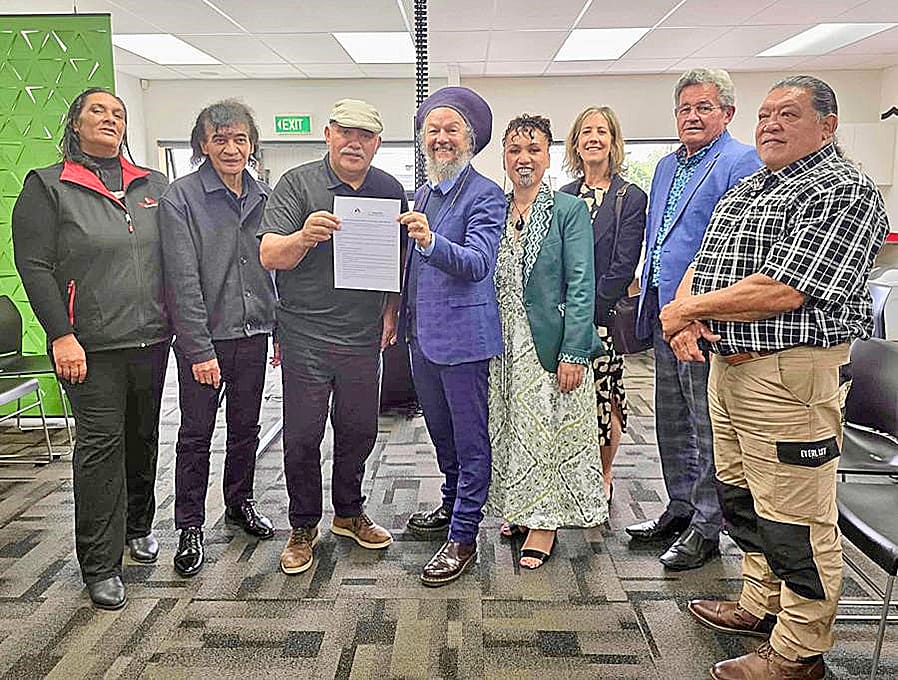
PARTNERSHIP: Te Rūnanga o Ngāti Manawa’s Terewai Kalman, Patrick McManus and Kani Edwards with Whakatāne Mayor Nandor Tanczos and councillors Toni Boynton, Carolyn Hamill, Andrew Iles and Jesse Morgan-Ranui at the signing of their Mana Whakahono ā Rohe agreement in November. Photo supplied
Diane McCarthy
Whakatāne Mayor Nandor Tanczos says the Government’s plans to scrap formal agreements between local councils and iwi is a backward step for local democracy.
“The relationships between council and tangata whenua are ongoing, enduring relationships that go far beyond the tenure of any particular government or any particular group of councillors,” he said.
“Why on earth would the Government want to throw those on the scrapheap? I don’t understand what they think they’re gaining from it.”
The Government announced on Monday that existing agreements between councils and iwi – referred to as Mana Whakahono ā Rohe agreements – would be replaced with “narrowly scoped iwi participation agreements”.
“We have become concerned about the rapid increase in new agreements and initiated processes between councils and iwi,” RMA Reform Minister Chris Bishop said.
“Eight existed when the bills were introduced late last year. Since then, several dozen more have been agreed or initiated.”
Whakatāne District Council has been working on several Mana Whakahono ā Rohe agreements with local iwi authorities.
It recently formalised a Mana Whakahono ā Rohe agreement with Te Rūnanga o Ngāti Manawa.
It is also close to completing an agreement with Te Rūnanga o Ngāti Whare and is working on an agreement with Ngāti Hokopū. Another agreement has been initiated by Te Mana o Ngāti Rangitihi.
Tanczos said it was “hardly surprising” there had been an increase in applications as the opportunity to do so was disappearing.
“We were assured that if they were submitted on time they would be fine.
“It just shows how much councils and iwi value the opportunity to formalise these relationships.”
It was about working together for the good of their communities, he said.
“That’s a good thing. Why on earth would you try to stop that happening?
“Particularly in a district like ours where we’ve got a 50 percent Māori population. The Māori economy is a massive driver of economic development, both in the district and in the sub-region of the Eastern Bay.”
He cited Kawerau and the partnerships that were being developed between iwi and international consortiums around geothermal energy.
“Look at the massive investment going into horticulture across the whole of the Eastern Bay – the value in some of the land trusts. There’s enormous investment going on, and it’s often under the radar.”
Tanczos said he was unhappy that it was being done after the Select Committee.
“So there’s no opportunity to make submissions on it or anything like that. It’s really destructive I think.”
Mana Whakahono ā Rohe were introduced in 2017 as part of the Resource Management Act.
The agreements establish formal processes for councils and iwi to share information, consult on resource consents, and reflect Treaty settlement obligations in local decision-making.
Under the RMA shake-up, the existing law will be replaced by two new pieces of legislation, the Planning Bill and the Natural Environment Bill.
The Environment Committee have recently reported back to Parliament after spending six months considering submissions on these bills.
When the bills were introduced there was a provision that Mana Whakahono ā Rohe agreements that already existed or had been initiated prior to the bill being enacted would transfer into the new system.
However, Bishop said the Cabinet has agreed that existing and initiated Mana Whakahono ā Rohe agreements will not transfer into the new planning system.
Instead, councils will have the option of entering into new, narrowly scoped iwi participation agreements.
“Clear guardrails will be included in the legislation to prevent scope creep.”
Bishop said the RMA changes would improve the workability of New Zealand’s new planning system while retaining its core design.
“It’s a big part of the Government’s plan to fix the basics, remove barriers to growth and build a stronger economy.”