
Team Kiwi Coupe get taste for Salt

Last month, Whakatāne’s Llew Gray and Team Kiwi Coupe headed to Utah in the United States to live the dream and brave the legendary Bonneville Salt Flats. It was an experience Gray, second from right, wife Tania Mischefski, mechanic Shane Newlands, left, and son Tom Gray, will never forget.
Troy Baker
The Bonneville Salt Flats are a massive 30,000-acre white salt pan located in Tooele County in northwestern Utah. Since the early 1900s, the area has attracted the brave, the adventurous and, according to Whakatāne’s Llew Gray, the crazy.
The flats have seen every type of land machine imaginable, from motorcycles to highly customised vehicles with jet engines strapped to the back.
Like so many before them, Gray and Team Kiwi Coupe had a challenge ahead of them when they arrived with their 1934 Plymouth, ready to try their luck on the salt.
The team arrived with a car that wasn’t quite finished, so the moment it was out of the box, they got to work.
“The area is totally uninhabitable for life. We were there nine days and saw one bird. We definitely suffered from a lack of resources and found ourselves driving around town at night, searching through scrap heaps looking for steel, getting chased out by security guards who wondered why we were there," said Gray.
“We found a tiny bit of movement in the steering box, but there were no bushes to be found, so we had to improvise, using plastic bungs from plumbers’ pipe so we could make it work. We had a similar issue with the clutch, which we managed to fix with a section of pipe we found on the ground. It was a number-eight-wire mentality. My mechanics did an incredible job,” said Gray.
Gray and his team spent nine days on the flats, preparing and racing the car through the various stages needed to work their way up the ranks. Each successive stage allowed the team to qualify for the next, with speeds increasing and the risks becoming greater.
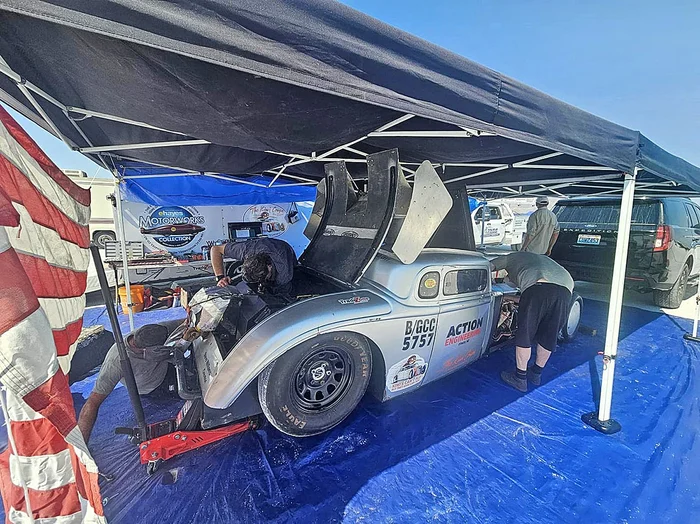
“The whole experience was crazy and incredible. It was the most far-out thing you can imagine, even dealing with the heat and glare, with car temperatures reaching 50 degrees Celsius. But our main goal was to just get there and drive, and I can say we did that,” said Gray.
The team worked their way through the licensing process, which increased in 50mph increments, finally managing to acquire a 205-300mph licence.
“Had some issues with the computer on the last run, which was reading the live data but not storing it. We did discover the car was low on fuel pressure. The car was running beautifully, but I couldn’t get it over 6600rpm, and it should have been leaning out to 8000rpm, so we only managed 224.5mph (361.2kmh) and didn’t go as fast as we could have.
“Driving the car meant there was a shitload happening all at once, and it was happening quick. Watching the temperature gauge, rev counter, speedo, track and mile markers with a lot to keep an eye on, you still have time with the pedal pinned to the floor to have those ‘woohoo’ moments,” said Gray.
The main course is six miles long, and there are two of those, followed by another four miles to slow down, totalling 10 miles, or 16 kilometres, of racecourse.
The race distance is covered in about a minute and a half. The push car takes around 15 minutes to travel the same distance to collect the car after each pass.
Once inside the car, the driver is strapped down so tightly that movement is very limited. The head is also locked into place, which Gray admits can make him feel very claustrophobic.
The car has no brakes and relies on a parachute to slow down.
“It’s an experience when you pop the parachute; it’s exhilarating. You have to keep your foot on the throttle to make sure the chute comes out square.
“We had a few oil leaks from the valve cover soak into the manifold heat covers, which was smoking the cab out. So, after popping the chute, I’m travelling at 200mph while trying to unstrap myself so I can open the hatch on the roof. I’m just about dying from smoke and fumes and can’t see where I’m going.
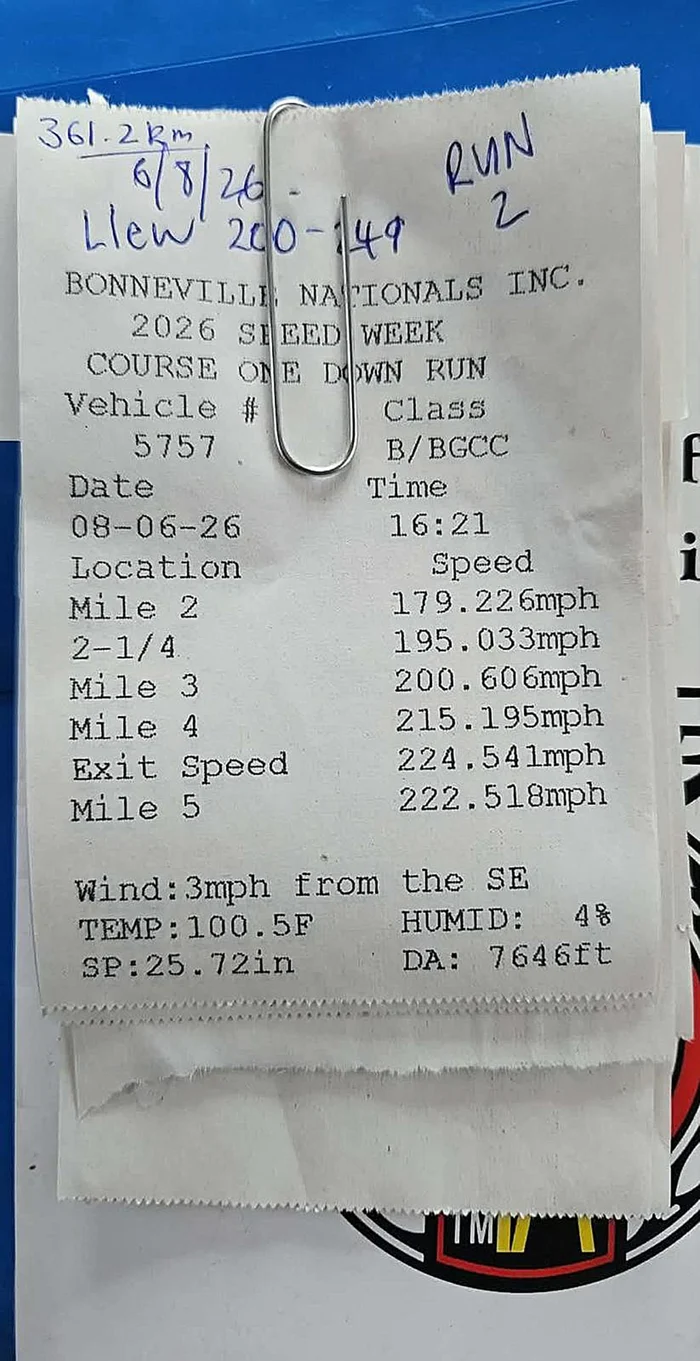
“The marshals always knew when it was the Kiwis on course because the car looked like it was on fire as it went past,” said Gray.
Despite meticulous planning, things can always go wrong and often do.
“A couple of cars did roll and come to pieces, and I saw drivers leaving in ambulances. I saw a guy five cars in front of me have his car explode.
“That closed the track for hours as a clean-up crew with magnets had to pick up every metal fragment. These pieces are a danger to other vehicles on course,” said Gray.
Another aspect of life on the flats that struck Gray was the way everyone supported each other.
“Everyone is there for the same reason and was like one huge family. Teams came over to borrow tools, helped us with parts and even let us use their workshops. The camaraderie was incredible,” he said.
Team Kiwi Coupe has walked away with fond memories of its time on the Salt Flats, but the team vows to be back next year in the hope of getting the best out of the car.
“The car is 100 percent mine now and is in storage in a shed about an hour out of Salt Lake City. We are definitely going back for another try next year, as we have unfinished business.
“We loved the whole experience and appreciate that we are now part of a special club. What makes it all even better is that I got to share it with family and friends,” said Gray.