
Whakatāne firefighter returns from huge US wildfire deployment

FIRE CREW: From left, Lauren Hasson, Mark Cleghorn, Gareth Wilson and Roger Nelson during the US wildfire deployment. Photos supplied
Tamara Herdman
A Whakatāne firefighter has returned home after spending more than five weeks battling wildfires in the United States as part of New Zealand’s largest-ever international deployment to the country.
Eastern Bay Volunteer Fire Brigade crew leader Mark Cleghorn left Whakatāne on August 10 and returned on September 16.
Cleghorn was part of a 21-person New Zealand task force sent to Washington State, where he worked as a firefighter in a four-person crew operating a federal fire engine.
The deployment began with two days of training and induction at the National Interagency Fire Centre in Boise, Idaho, before the team travelled to northern Washington.
Cleghorn spent two weeks working on the Little Giant Fire, near Entiat, before taking three days of rest and recovery near Seattle.
He then spent another two weeks working on the Sinlahekin Fire, closer to the Canadian border.
The scale of the fires was unlike anything Cleghorn had experienced in New Zealand.
The Little Giant Fire covered about 160,000 acres, while the Sinlahekin Fire was around 170,000 acres. For comparison, New Zealand’s largest individual wildfire in recent records, the 2020 Lake Ōhau fire, burned about 12,500 acres.
A typical day started at about 5.30am with breakfast, briefings and preparations before crews headed to the fire line at about 7.30am.
They could spend more than an hour travelling to their assigned section of the fire before beginning work.
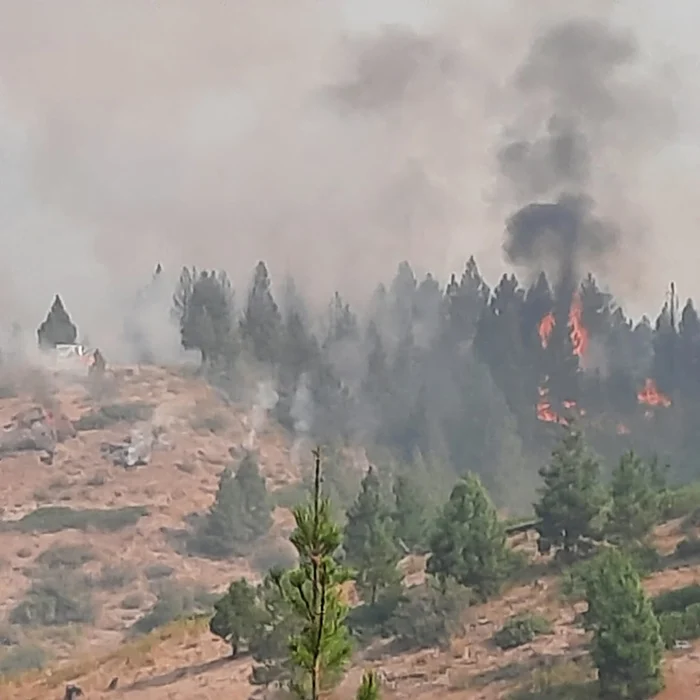
Tasks included traffic control for tree fellers, walking fire perimeters and establishing “black lines” – clearing strips of vegetation to help prevent the fire from spreading – as well as patrolling for hotspots and responding to reports of smoke.
“We were generally assigned an area of the fire to work on and given a task for the day, which could vary depending on what was needed,” Cleghorn said.
Crews worked up to 12-hour days, sometimes not returning to camp until 7.30pm.
The conditions were often smoky and ashy, and temperatures varied dramatically from mid-30s to single-digit temperatures, with the crews even experiencing a little snow on one of the fires.
One of the biggest challenges was returning to the same areas day after day searching for hotspots.
“You really had to motivate yourself to keep being thorough and doing a good job. But I think our crews did a really good job of keeping each other motivated,” Cleghorn said.
On one occasion, while the crew was carrying out traffic control at high elevation, a spot fire started below them and quickly travelled up a ridge.
The crew could see crowning flames and hotspots while water bombers worked below them, dropping water on the fire.
Despite the scale of the fires, some of the greatest dangers were not necessarily the flames themselves.
Dangerous trees, vehicles and wildlife were among the major risks.
Crews were driving large vehicles along narrow tracks cut into mountains, with heavy traffic moving around the firegrounds.
A vehicle went off the road into a ditch during the deployment, although nobody was injured.
The crews also encountered bears, including a mother and two cubs crossing a road in front of them, while a moose nearly collided with a vehicle.
Towards the end of the deployment, one of his crewmates spotted another flare-up near the edge of the unburnt area.
The crew spent the next day and a half working to put it out before it had the opportunity to spread again.
“It was a really good catch by one of our crew,” Cleghorn said.
Cleghorn has previously been deployed to Tasmania, New South Wales and twice to Alberta in Canada, and said the US deployment was similar to his previous Canadian experiences in terms of terrain and vegetation.
The major difference was the sheer scale of the response.
One of the camps the crew stayed at housed about 1800 people in tents.
“The Americans have lots of resources, and they throw lots of resources at fires,” he said.
Heavy equipment, diggers, bulldozers and aircraft all worked alongside firefighters.
“It’s really valuable for us to go over and be a part of that because we very seldom get big fires here,” Cleghorn said.
The deployment also gave him the opportunity to work alongside firefighters from Australia, the US and other parts of New Zealand.
American firefighters were embedded with the New Zealand units to help with differences in equipment, terminology and procedures.
Cleghorn said strong friendships were formed during the deployment.
He also returned with practical knowledge that could be useful in New Zealand, including a troubleshooting method used by American firefighters for high-pressure water pumps.
Both fires Cleghorn worked on remain active, although they are now largely contained.
As of September 30, both the Little Giant Fire and the Sinlahekin Fire were 93 per cent contained. Deep-seated hotspots and burning root holes remained within the fire areas. Cleghorn said the remaining internal fires could either burn themselves out or be dealt with by the coming snow.
The 57-person New Zealand contingent was the largest of three New Zealand deployments to North America during the 2026 fire season.
He said the New Zealand firefighters were told by American colleagues they were impressed by their attitude and work ethic.
“I’m really proud of that,” he said.
He said the deployment would not have been possible without the support of his family, friends, employer and fellow brigade members.
“Just little things like having my dog looked after and having somebody to check the house while I was away and the load that my staff and fellow employees at work took on board to cover while I was gone was what made it possible to go,” he said.