Louise steps away after 29 years with Neighbourhood Support

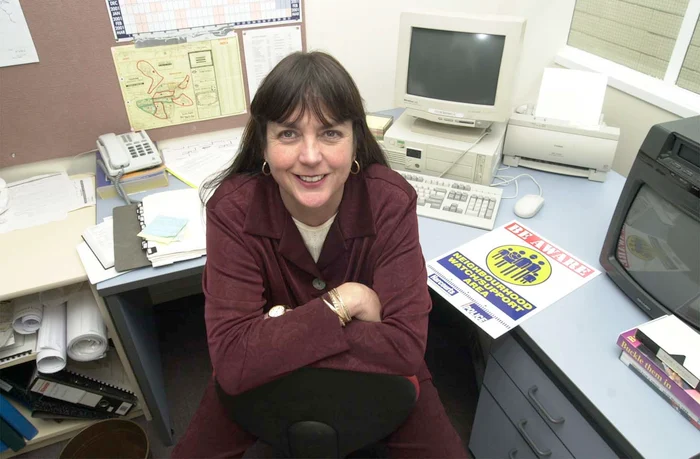
Then and now: Louise Milton at her Neighbourhood Support desk in 2000, above, and below, after 29 years’ service, she is stepping away. Photo Aston Palmer E6197-01
Aston Palmer
After 29 years building and growing Neighbourhood Support, Louise Milton has stepped away.
She leaves a network that grown from seven known groups at her arrival to almost 400.
Milton said it was not an easy decision to leave, but the organisation had reached a point where it needed others to take it forward.
“To be truthful, it’s hard,” she said. “But there’s a coming point when you stop being a good thing for the organisation and other people take it on and grow it from there.”
Milton has confidence in those continuing the work and the relationships established with emergency services.
Her involvement with Neighbourhood Support began unexpectedly after she attended a parent-teacher association meeting at Awakeri School.
Community constable at the time, Barry Shiels, was invited to speak about crime prevention and the interest generated led to Milton being asked if she would take on a role with Neighbourhood Support.
She agreed, initially working unpaid for about 18 months.
“I was given a 1000-year-old computer, give or take, a wee desk chair, and a filing cabinet,” she said. “That’s what I started with.”
At the time, there were just seven known groups, with little information available about who was involved or where groups were operating.
She looked at how the organisation had been set up in 1975, which she understood involved Federated Farmers and Neighbourhood Watch, and set about rebuilding its structure and creating a system that could operate and expand without depending on one person.
Her approach involved dividing the community into sectors, with a coordinator for each, connecting those coordinators with neighbourhood groups, families and emergency services.
The work also involved a lot of public meetings and developing relationships with the people and services that communities could turn to for support.
In the early days, communication was very different.
Information was shared through phone calls, school newsletters, newspapers and radio advertisements. Without a database, information and resources had to be put together manually.
Milton said one of the important aspects was making sure neighbours felt comfortable looking out for one another and asking for help when they needed it.
People sometimes needed reassurance that it was acceptable to contact their neighbours, even in the early hours of the morning, if they felt unsafe or noticed something suspicious.
“It was amazing to be able to help people, to give them the strength of working together,” she said.
She said bringing people together was one of the biggest achievements; she enjoyed the group meetings and seeing communities support each other.
Milton worked as manager until 2003, when she left for health and family reasons. However, her involvement did not end there.
She remained connected through the trust, chaired it at different times and returned to help with the role when needed.
Over the years, she estimates the organisation has grown to about 390 groups.
For her, the next chapter means trusting the people who have taken on the work at Neighbourhood Support and allowing them to develop it further.
She said the relationships with emergency services remained strong and the organisation had good support around it.