Students put election candidates to the test

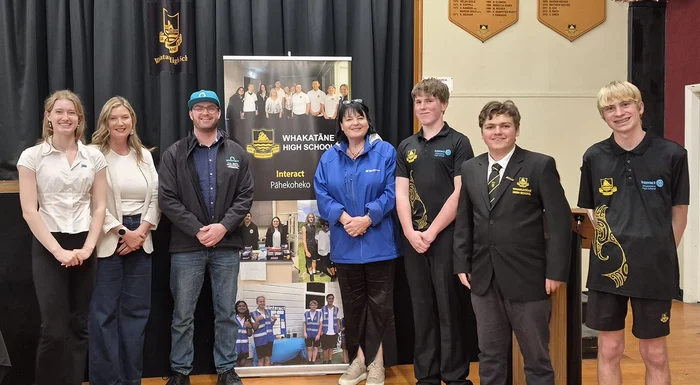
Quick answers: Candidates Jo Luxton, Dana Kirkpatrick, Cail Smith and Gordon Dickson answer quickfire questions using “yes” and “no” paddles at the Whakatāne High School Interact Club debate. Photo Aston Palmer E6211-02
Aston Palmer
Whakatāne High School’s Interact Club hosted a meet-the-candidates night on Wednesday, giving the community an opportunity to hear from local candidates ahead of the general election.
The Labour, National and Opportunity parties were represented, alongside independent candidate Gordon Dickson from Ōhope. The Green Party and ACT were unable to attend.
Before a small crowd of 27 people, the candidates responded to questions on a range of issues affecting the country and its younger generations.
They included questions on the economy and cost of living, unemployment, education, conservation, local government reform and support for young people. Candidates were also asked about charter schools, school lunches, the environment, healthcare and the cost of buying a first home.
Students took an active role in running the debate, introducing questions, passing the microphone between candidates and keeping speakers to their allotted time.
Although some answers strayed from the questions, the students worked to keep the evening moving.
The candidates offered different views on issues affecting young people, including education and the opportunities available to them in New Zealand.
Labour candidate Jo Luxton said young people needed “feel a sense of hope”.
She also spoke about the need to give young people opportunities to build a future for themselves in New Zealand rather than overseas.
Incumbent MP and National candidate Dana Kirkpatrick spoke about the importance of getting students to school, saying attendance was a key part of addressing education challenges.
“If kids aren't at school, they can't learn and that's the first and foremost thing they need to address,” she said.
Kirkpatrick also raised concerns about government debt, saying, “we can't just keep adding to the debt mountain.”
Opportunity Party candidate Cail Smith spoke about the challenges facing young people, including mental health, and said teachers were not responsible for every problem within the education system.
“I'm not a fan of putting blame on the teachers; I think the teachers are doing a fantastic job,” Smith said.
“I think there is a lot of struggle in today's youth around mental health, which is something that resonates very strongly with me.”
The debate also included a series of quickfire questions, with candidates asked to respond to topics including GST, regulations, the minimum wage, fees-free study, Youthline, student transport, the voting age and compulsory voting.
Other questions touched on the environment, nuclear-free policy, Māori wards, MMP and the use of artificial intelligence, smart phones and social media in schools.
Independent candidate Dickson at times moved away from the questions, prompting the student host to remind him to address the topic and that the debate was taking place at a school.
Audience members also urged Dickson stay on topic.
Despite the challenges of managing different speakers and keeping the discussion on track, the students received praise for how they organised and ran the evening.
Their teacher, Linda Bonne, said she was proud of the students and the way they handled their responsibilities throughout the debate.
“They never cease to amaze me,” she said.
She said the students had been well prepared and remained professional throughout the event.
The evening gave voters a chance to hear candidates discuss their positions on a range of issues, while also giving students experience in organising and hosting a public political discussion.
Voter enrolment for the November general election closes on October 25.