
New base boosts search and rescue

TEAM EFFORT: Whakatāne Land Search and Rescue members in front of their new base. Dan Edgecombe, Steve Woods, Mark Looney, John Bell, Christian Anderson, Karl Hunt, Tiki Hutchings, Daniel Houlbrooke, Teisha Curtis, Tom Brown, Jess Walker, Trudy Howard, Lyndal Kennedy, Darryl Howard, Gordon Townsend, Sarah Millar, Marty Sanderson, Michelle Dale, Mike Lawton and Aimee Dawson. Photo Aston Palmer E6221-01
Aston Palmer
Whakatāne Land Search and Rescue has opened a new operations base, giving volunteers a permanent place from which to coordinate searches and respond to emergencies.
The base, which officially opened on Wednesday, has been six years in the making, with volunteers fundraising, designing and fitting out the room themselves.
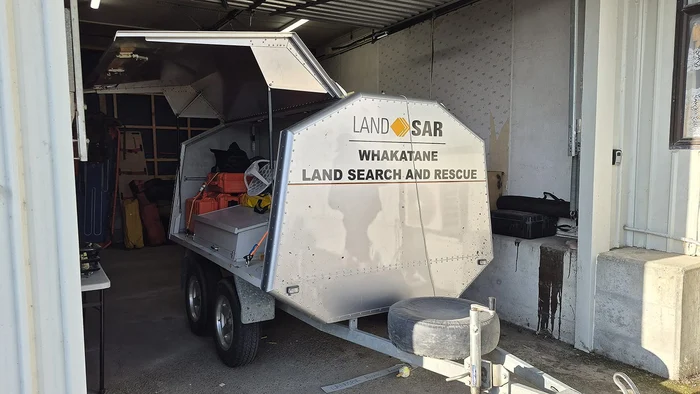
Whakatāne Land Search and Rescue chairperson Darryl Howard said the group had previously operated out of a trailer, a shed or even someone's kitchen during searches.
The team is grateful to St John for providing the space, which was previously a storeroom in the ambulance building on Arawa Road.
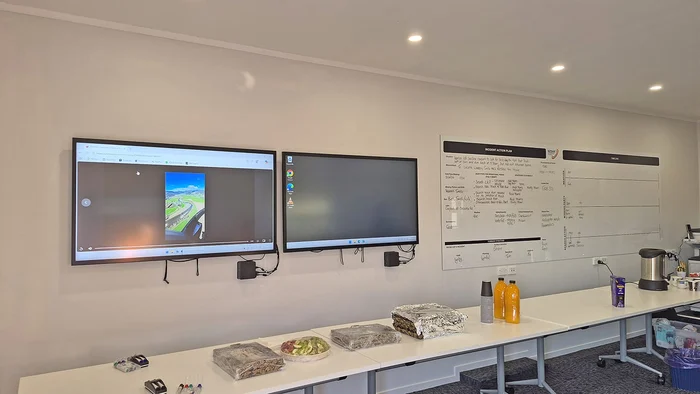
The room has been transformed into a high-tech operations centre, with large touchscreens, computers, fast internet and whiteboards to help search teams plan and coordinate their efforts.
Christian Anderson explained how the technology allowed search teams to display maps of search areas and quickly share information about the work already completed.
The team use digital systems to track searchers and their movements, allowing them to see which areas have been covered and identify places that may still need to be searched.
Anderson said having the information displayed on the walls helped people arriving at the base quickly understand the situation and the work already done.
An improved internet connection, including Starlink, allows the team to maintain communication with searchers in the field.
Whakatāne Land Search and Rescue team manager Mike Lawton said the police were responsible for running search operations, with the volunteer team helping coordinate the effort.
When someone is reported missing, lost or injured, the team gathers information, develop a plan and decide which resources are needed. These may include search teams, dogs, drones or helicopters, depending on the situation.
Lawton said the room allowed the incident management team to begin planning immediately, rather than spending valuable time setting up equipment and internet connections.
“As soon as the phone rings, it's ready,” Lawton said.
There is a separate radio area, allowing for uninterrupted communication with searchers.
Howard said the facility was intended to benefit the whole Eastern Bay community, with other emergency services, including police and fire services, able to use it when needed.
The team has already coordinated several searches from the room, with members describing it as a significant time-saver.
Search and Rescue volunteers are on call 24 hours a day, seven days a week and can be called out at any time, including during the night and in difficult weather.
The group’s next project is to develop the neighbouring shed for equipment and trailer storage.