
Hillary Challenge team surprises at national finals

WHAKATĀNE CHALLENGE: Gabriel Aruquipa salutes the camera with team members, Kamea Aldridge, Ollie Peat, Luca Goodman, Sachin Marston, Addie Tetze, Tylah Bateson and Rose Morton. Photos supplied
Troy Baker
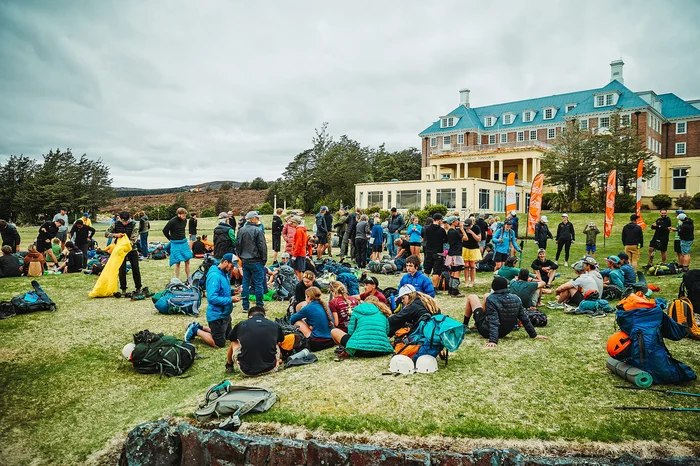
It was a chilly minus-3 degrees as students from Whakatāne and Trident high schools prepared to take on five days of mental and physical challenges at the Hillary Outdoors Centre near Turangi earlier this month.
Under the guidance of coach Ella Julian, with Campbell Gray providing support, the Whakatāne students had trained hard in the lead-up to the event with early-morning sessions during the week, as well as weekend workouts, increasing in intensity as the challenge approached. Everything appeared to be on track until a late change disrupted the team’s preparations.
“Two weeks out, everything was looking good, but we had issues replacing our navigator after Kayla Follows came down with glandular fever at the start of the year. She couldn’t train on the track and struggled to recover from training sessions and was forced to admit participation was going to be an issue,” Julian said.
“We ended up dividing the role between two of the boys to take on navigation and replacing Kayla’s spot with Rose Morton, who took some convincing but meshed in well with the team.
“We were a new team, with five out of the eight athletes taking on the Hillary Challenge for the first time, so we used this as a chance to build skills and experience.”
The Hillary Challenge takes place over five days, with six one-hour challenges each day. The tasks test mental and physical strength, teamwork and individual resilience.
Teams are loaded into vehicles and dropped off in the mountains with their packs and equipment. From there, they face two days of navigation challenges before being collected and returned to base camp for an overnight rest.
The final day features a gruelling 60km multisport race, which can be especially difficult after several days of exertion, when tired bodies must find the energy to get moving again.
Unlike last year’s event, which was described as hazardous, the weather worked in favour of Whakatāne’s new navigators, making their task easier.
With so many newcomers in the team, Julian focused on development and building experience, with an eye towards a stronger competitive push next year.
“We will lose a couple of members next year, but we will have five who will be experienced. This year we were relaxed and looking to have fun, and the fact the team were so close-knit made for a great five days,” she said.
The final day’s 60km challenge often brings its own battle, with exhausted competitors struggling to get out of bed and to the starting line.
“We usually have to make several trips to wake them up, and we were expecting the girls to be like last year, when they were broken that morning and couldn’t comprehend how they were going to get to the start line, let alone get through 60km.
“This year I walked into the bathroom, and they were up and raring to go. The takeaway from last year was that they had never pushed themselves that hard before, with the mind being the limiting factor. It was incredible watching them this year,” Julian said.
Julian and Gray were impressed by how quickly the team gelled, worked together and adapted to the challenges, with several members producing standout performances.
“Rose, the ring-in, turned out to be our strongest rider, posting some of the fastest times of any team, which surprised not only us but her as well.
“Luca Goodman and Ollie Peat, the replacement navigators, really shone, while Addie Tetze, a new entrant, impressed at every challenge.”
One of the biggest surprises came during the final day’s paddle. Whakatāne left the transition area in last place, but the team’s effort on the water saw them climb through the field.
“The paddle on the last day is where we thought it would all fall over, as they left the transition last, only for Whakatāne to exit run in third place.
“We couldn’t believe it and convinced ourselves there was a mistake, so we asked the marshals to double-check,” Julian said.
Once the dust settled, Whakatāne had finished the Hillary Challenge in sixth place.
“The overall team performance was outstanding, and I think the result doesn’t reflect how strong they were,” Julian said.
The 2026 challenge leaves the team is a good position to build towards their 2027 campaign.
With potentially more experience member for the team, the hop is for a podium finish next year.