Repair café concept popular as ever

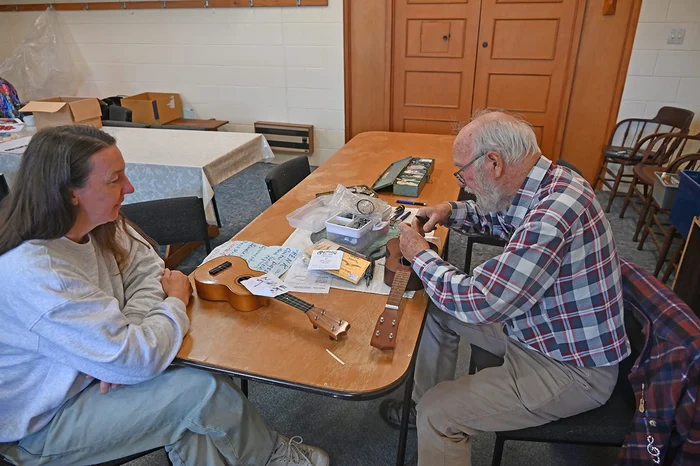
HANDS ON: Electrician Phill Taiapa and retired engineer Bruce Stables are at work watched by Sharon Johnston. Photos supplied
Paul Charman
The Ōpōtiki Repair Café at the Masonic Hall has been quietly gathering momentum, with the next one scheduled for this Saturday.
The event is supported by a steady stream of visitors, who gather on the last Saturday of the month, carrying in a wide variety of goods to be repaired by volunteers.
Since the activity started four years ago, items brought along have included electrical appliances, broken clocks and watches needing batteries, chairs and furniture, damaged clothing, musical instruments, and even knives to be sharpened.
In most cases the work is done in return for a koha, plus the cost of parts if needed, and visitors help themselves to tea and coffee while they wait.
The Repair Café movement was founded in Amsterdam in 2009 by a Dutch journalist, Martine Postma, who was inspired by a design exhibition highlighting the environmental benefits of repairing and recycling.
There are now more than 3000 repair cafes worldwide, with the first one in New Zealand opening at Lyttelton Harbour in 2013.
Volunteers Phill Taiapa and Bruce Stables said they found the work challenging and appreciated the opportunity to help people restore damaged or worn-out possessions.
“It gets me off the couch, helps keep me active and I enjoy the challenge,” said Stables, who looks after time pieces, repairing clocks and replacing watch batteries.
The oldest clock he repaired was built in 1780, having been brought to the district when it was already about 100 years old.
“Some of the grandfather clocks he has seen have come in with complex problems to solve and some have even needed parts made.
Both he and Taiapa have taken more complex jobs home to complete in their own time.
Taiapa a qualified electrician, was working on an electric jug whose parts were worn out. Though he can sometimes repair such items, in this case he had advised the owner to purchase a new jug, though pointing out that the charging base was still worth keeping.
The oldest item he had repaired was a Maytag drier, between 40 and 50 years old, which had needed a new belt.
“I put the part number on the Internet and to my astonishment found I could still order one. That part must have been sitting in a warehouse all those years.”
Retired instrument repairer and music teacher Henk Hoogland was fixing some modest ukeleles for a woman’s grandchildren to play. He was using old parts to keep the cost down for his client.
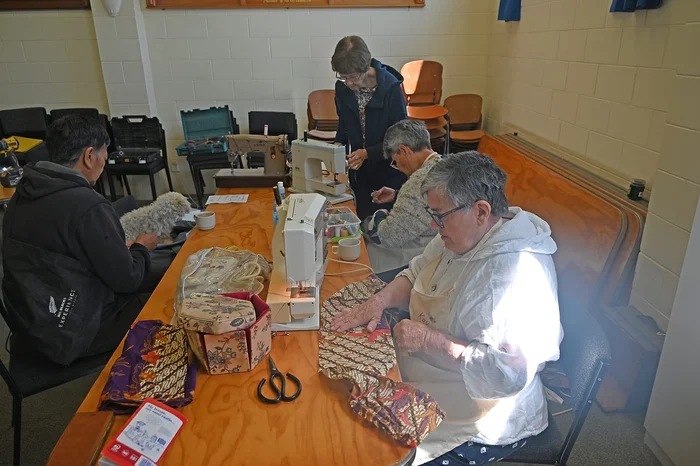
Sewing specialist Kay Hitchcock was working on a range of garments old and new.
She said people particularly appreciated having somebody alter hems on clothing that needed adjustment.
Facilitators Lynne Hickling and Meg Collins said these were typical among the challenges people brought along to the repair café, though the range of items was huge and there were too many scenarios to list.
The idea is for people to buy items of good quality locally and when or if they failed to get them repaired in town if possible.
“Ideally, we’d like to see people repair items and make them last as long as possible, rather than continually buying new ones manufactured overseas.
“Let’s keep the money in New Zealand if possible,” Hickling said.
Collins pointed out that the Ōpōtiki District Council supported the repair café because it recognised the positive aim of reducing the amount of waste going to landfill.
“The movement in Aotearoa New Zealand centres on shifting away from a throwaway consumer culture by fostering a practical, community-led culture of repair, sustainability, and shared knowledge,” Collins said.
“What’s more it’s a great place to visit with a positive vibe. Why not come along and see for yourself this Saturday.”