Rural students encouraged to consider health careers

Sweet talk: Former Trident High School student Finn McCleary shares his journey into dentistry, answers questions and leads a fun activity challenging year 10 Whakatāne High School students to guess the sugar content of different drinks. E62
Kathy Forsyth
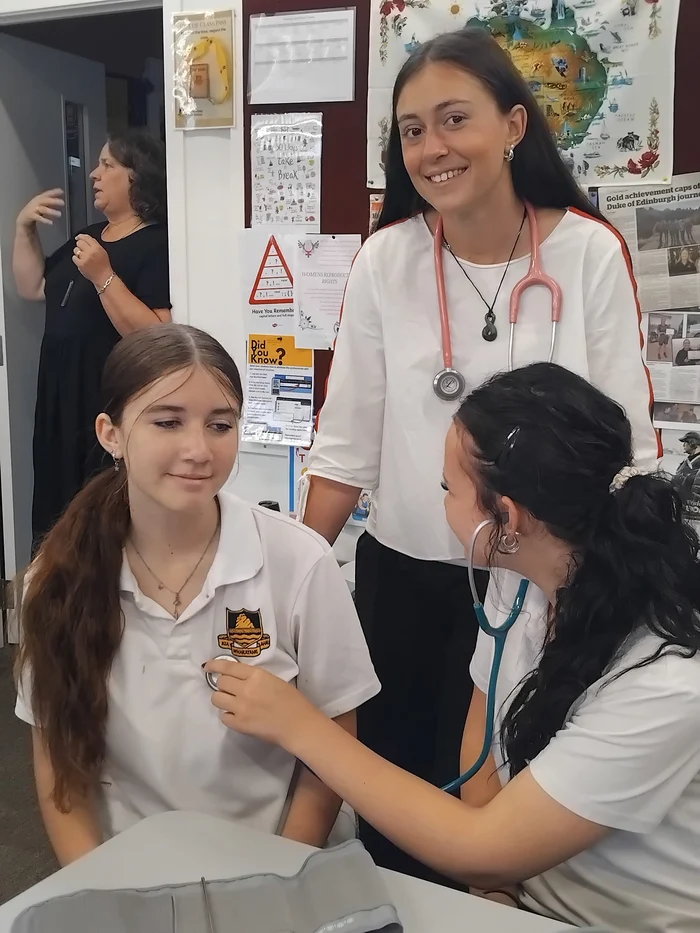
Eastern Bay high school students have been getting a taste of healthcare careers, with university students visiting rural schools to share their experiences and encourage the next generation of health professionals.
The Hauora Taiwhenua Rural Health Network brought its Rural Health Careers Promotion Programme to Tarawera, Murupara Area, Whakatāne and Trident high schools last week.
Among the volunteers was former Trident student Finn McCleary, who is heading into the fifth year of his dentistry degree next year. The group also included three medical students and students studying nutrition, dietetics and social work.
Through hands-on activities, the volunteers introduced students to different health careers and shared their experiences of tertiary study.
At Whakatāne High, McCleary was keen to give the Year 10 students an insight into the different pathways into healthcare.
He had enjoyed studying science at Trident, he said, but had been unsure what he wanted to do after leaving school.
“I didn't know what was out there. I was never really told that dentistry was a career. It wasn’t until I stumbled across an open day at Otago University.
“After doing a little bit of reading about dentistry, I was like, wow, that looks like a lot of fun.”
The opportunity to improve people’s lives was also a strong drawcard.
McCleary said encouraging more young people from rural communities to enter health professions could help address inequities in access to healthcare.
“Rural communities, including Māori and Pasifika communities, have inequitable health outcomes.
“But a lot of these medical pathways are filled by people who aren’t from rural areas, and they often move back to cities. So, access to healthcare in rural areas is usually really hard to come by.”
During visits to Kawerau and Murupara, he heard from students who had not visited a dentist for years. Having more rural students enter health professions and eventually return to their communities could help improve access to services, he said.
McCleary hoped to be among them.
“I am very much looking to come back to Whakatāne.”
The volunteers also discussed barriers to tertiary study, including costs, and outlined scholarships, Māori, Pasifika and rural entry pathways, and university support.
Medical student Zacky Harris, heading into his third year at the University of Auckland, wanted to show young people that a healthcare career was achievable regardless of their background or school results.
“I went into university doing engineering and I completely did a 180 into healthcare,” he said.
“We just want to get the point across that going into university is not hard. Everyone seems to view university as having this barrier. We want to show everyone that it's possible.”
He said bridging courses and university support were available to help students make the transition.
“As long as you put yourself out there and try new things, doors are never closing.”
Hauora Taiwhenua Rural Health Network co-ordinator Francesca Grove Sigal said university students acting as ambassadors helped make health careers more accessible.
Many volunteers came from rural backgrounds themselves and understood the challenges faced by students in smaller communities.
“Especially in rural areas, there can be a bit of a gap between students seeing themselves in these careers. Potentially, not many people in their family or community might have gone into tertiary education, and it can seem quite daunting.”
Whakatāne High School student Hinetara Smith said the visit had opened her eyes to the possibilities within healthcare.
“To be honest, I wasn’t really interested in anything medical,” said Hinetara.
“But these students have made it really interesting because now I’m actually thinking that maybe dentistry could be my thing in the future.”
She had also been surprised by the range of different career pathways available.
Hauora Taiwhenua’s Rural General Practice Survey 2026 found 85 percent of rural general practices wanted to host health students over the next 12 to 18 months. It also highlighted workforce shortages across a wide range of health professions.
Chief executive Dr Grant Davidson said building a strong rural health workforce requires a long-term approach.
“Taking health career experiences into rural schools gives students the chance to hear from people who are already studying in the sector, ask questions and learn more about the pathways available.”