Trades academy builds more than just houses

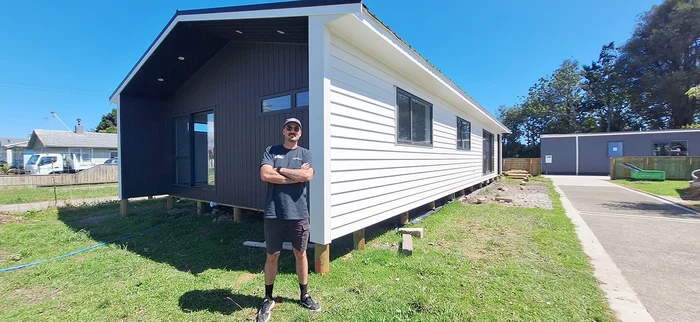
The Eastern Bay Trades Academy is looking forward to 2027 with plans for expansion and exciting projects ahead. Pictured, from left, apprentices Puawai Nepia and Sam Aramoana, managing director Woody Gilmour, builders Brendon Wakeman and Mike Wilson and apprentices Walter Paruru and TeRaiwa Maki in front of one of their latest projects, a joint venture on Buchanan Street with Jennian Homes for three Kāinga Ora Homes.
Rufus Dempsey
A building enterprise giving Eastern Bay rangatahi a head start in the trades is expanding its horizons, with transportable homes for sale now helping fund a future built on opportunity.
Two years ago, the Eastern Bay Trades Academy was facing the prospect of closure after funding was cut to the iwi project that had been providing local college students with a pathway into the building industry.
Today, the academy is not only still standing but preparing to take on the highly competitive transportable-home market, with a growing operation that is building houses while building futures for Eastern Bay rangatahi.
The turnaround came through a partnership between Whakatōhea, Ōpotiki College and teacher Woody Gilmour, who believed the programme was too valuable to lose.
“The results and the successes of the scheme were just too good to lose to a funding cut, so we took over the responsibility to start the enterprise as a limited liability company, separate from the college but contracted to provide the NCEA Level 3 training,” Gilmour said.
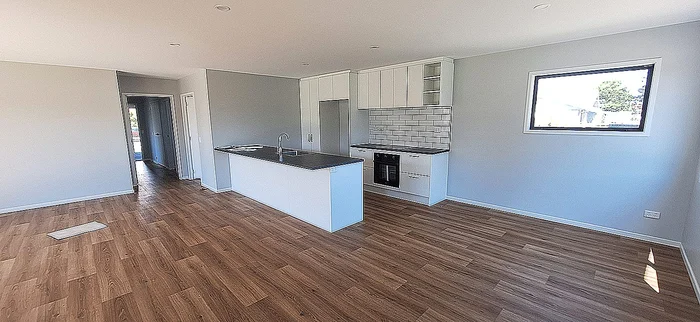
Now, two years on, the academy is entering the private market, offering fully finished one, two, three and four-bedroom transportable homes that can be purchased from plans and delivered to sites throughout the Bay of Plenty.
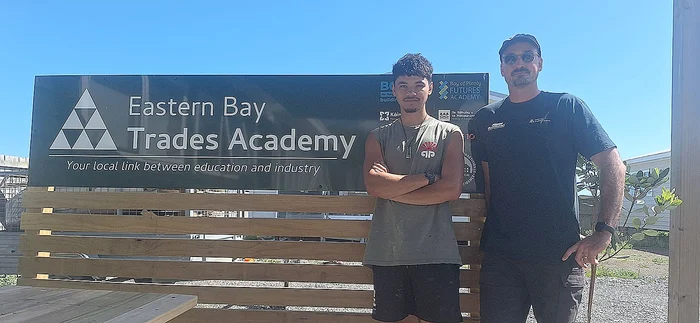
Initially supplying homes to Kāinga Ora, the decision to diversify into the private market is another step in growing the enterprise and creating a sustainable future for the training programme.
But while the houses might be the most obvious product, Gilmour says the real value of the operation is being measured in the young people coming through its doors.
An architect by training, Gilmour spent two years in the profession before making the move into teaching, initially joining his wife in the education sector.
He has spent the past 11 years teaching technology and woodwork at Ōpōtiki College but recently resigned to devote his time entirely to the trades academy, where he is managing director alongside director and course co-ordinator Steve Mahy.
The academy now operates from yards in Ōpōtiki and Te Kaha, with 16 Ōpōtiki College students and eight students from Te Kura o Te Whānau-a-Apanui currently enrolled.
Next year, the programme is expected to expand again, with a new site at Edgecumbe bringing another eight students from Rangitāiki College into the fold.
Year 12 and 13 students build every home under the supervision of licensed building practitioners, gaining practical experience while completing their NCEA Level 3 training.
The homes are designed by award-winning First Light Studio and built to the same standards expected of any building company in New Zealand. Each comes with a Code Compliance Certificate and a Halo 10-year residential guarantee.
For prospective buyers, the homes offer a range of finished accommodation options that can be purchased from the plans and transported to their chosen site.
For the community, buying one also represents an opportunity to support an enterprise with a much wider purpose.
Gilmour said the social return on investment was estimated at around $9.40 for every dollar spent, while in 2025 every graduate of the programme progressed into employment or further industry study.
A key part of the academy’s approach is recognising that not every young person thrives in a traditional classroom.
Gilmour said a number of students arrived having become disengaged from mainstream education, with some reporting attendance rates of just 30 to 50 percent. But the opportunity to learn through practical, hands-on work could make a remarkable difference.
One student who had been attending school only around 30 percent of the time increased his attendance to 85 percent after joining the programme.
The academy also makes a point of employing at least one former student into its team each year, providing role models who understand the journey the current trainees are undertaking.
“We like to hire at least one of our former students back into our team here every year as a tuakana. They make great role models as the students see themselves in them and many are often related to our incoming students, which makes for a great whānau environment,” Gilmour said.
One of those success stories is 19-year-old Whera Pirini, who graduated from the academy in 2024 and is now working for Pōhutukawa Plumbing.
Already gaining valuable industry experience, Pirini is on track to become a fully qualified plumber, gasfitter and drainlayer, with around two years remaining in his training.
He is now also carrying out much of the plumbing fit-out work on the academy’s own builds.
Pirini credits the opportunity with giving him the direction he needed after finding school difficult.
“If I hadn’t taken this up, I wouldn’t be in the position I am now. I wasn’t the best at school, and this was perfect for me. I am so glad I gave it a go, and it is the reason I have the job I do now,” he said.
For anyone considering purchasing a transportable home, the academy is encouraging buyers to take a look at what is on offer, with the added knowledge that their purchase is supporting a local enterprise investing directly in the next generation of tradespeople.
It is an opportunity to put money back into the Eastern Bay community while helping ensure more young people have access to the skills, experience and employment pathways needed to build secure futures.
Ultimately, the academy’s success cannot be measured solely by the number of houses rolling out of its yards, the value of its sales or the figures on a balance sheet.
It is reflected in the confident, bright-eyed young people who have found their feet, discovered what they are capable of and are now looking ahead with genuine hope for the future.
And that is arguably the most important thing the academy is building.